Appendix V. to the second report on quarantine : report of Dr. W.H. Burrell on the plague of Malta in 1813.
- Great Britain. General Board of Health
- Date:
- 1854
Licence: Public Domain Mark
Credit: Appendix V. to the second report on quarantine : report of Dr. W.H. Burrell on the plague of Malta in 1813. Source: Wellcome Collection.
Provider: This material has been provided by King’s College London. The original may be consulted at King’s College London.
66/114 (page 54)
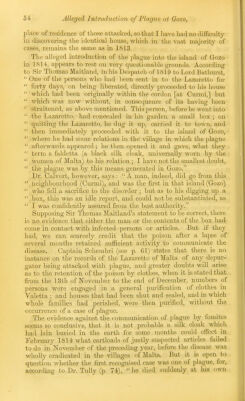
![place of residence of those attacked, so that I have had no difficulty ill discovering tlie identical house, which in the vast majority of cases, remains the same as in 1813. The alleged introduction of the plague into the island of Gozo in 1814, appears to rest on very questionable grounds. According to Sir Thomas Maitland, in his Despatch of 1819 to Lord Bathui-st, One of the persons who had been sent in to the Lazaretto for forty days, on being liberated, directly proceeded to his house which had been originally within the cordon [at Curmi,] but Avhich was now without, in consequence of its having been straitened, as above mentioned. This person, before he went into the Lazaretto, had concealed in his garden a small box ; on quitting the Lazaretto, he dug it up, carried it to town, and then immediately proceeded with it to the island of Gozo, where he had some relations in the village in which the plague afterwards appeared; he then opened it and gave, what they term a faldetta (a black silk cloak, universally worn by the women of Malta) to his relation ; I have not the smallest doubt, the plague was by this means generated in Gozo. Dr. Calvert, however, says : A man, indeed, did go fi-om tliis neighbourhood (Curmi), and was the first in that island (Gozo) who fell a sacrifice to the disorder ; but as to his digging up a box, this was an idle report, and could not be substantiated, as I was confidently assured from the best authority. Supposing Sir Thomas Maitland's statement to be correct, there is no evidence that either the man or the contents of the box had come in contact with infected persons or articles. But if they had, we can scarcely credit that the poison after a lapse of .several months retained sufficient activity to communicate the disease. Captain Schembri (see p. 61) states that there is no instance on the records of the Lazaretto of Malta of any depur- gator being attacked with plague, and greater doubts will arise as to the retention of the poison by clothes, when it is stated tliat from the 13th of November to the end of December, numbers of persons were engaged in a general purification of clothes in Valetta ; and houses that had been shut and sealed, and in which whole families had perished, were then purified, without the occurrence of a case of j)lague. The evidence against the communication of plague by fomites ■seems so conclusive, that it is not probable a silk cloak wliicli had lain buried in the earth for some months could effect in February 1814 what cartloads of justly suspected articles failed to do in November of the preceding year, before the disease was wholly eradicated in the villages of Malta. But it is open to question whether the first recognised case was one of plague, for, according to Dr. Tully (p. 74), he died suddenly at his own](https://iiif.wellcomecollection.org/image/b21297885_0066.jp2/full/800%2C/0/default.jpg)