Volume 1
Arts, manufactures, professions and trades : designed as a comprehensive supplement to the pharmacopoeia and general book of reference for the manufacturer, tradesman, amateur, and heads of families.
- Arnold James Cooley
- Date:
- 1880
Licence: Public Domain Mark
Credit: Arts, manufactures, professions and trades : designed as a comprehensive supplement to the pharmacopoeia and general book of reference for the manufacturer, tradesman, amateur, and heads of families. Source: Wellcome Collection.
Provider: This material has been provided by Royal College of Physicians, London. The original may be consulted at Royal College of Physicians, London.
66/916 page 50
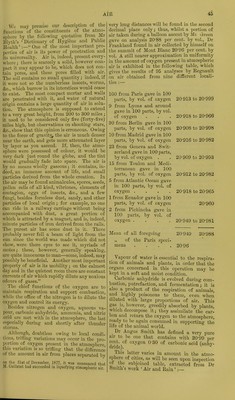
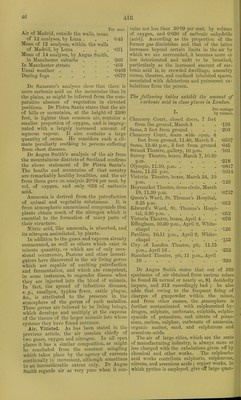
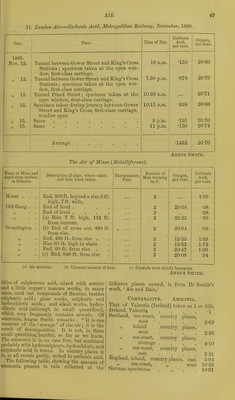
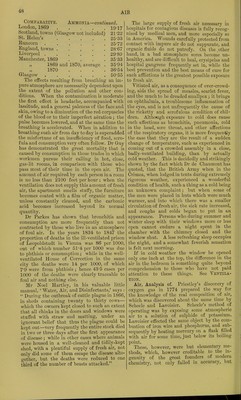
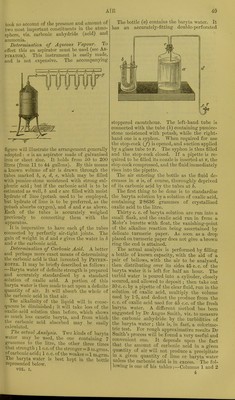
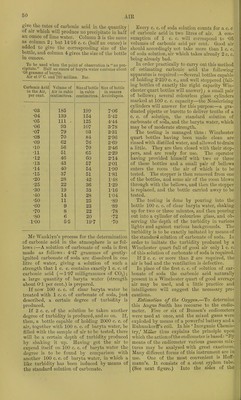
![give the rates of carbonic acid in the quantity of air wliich will produce no precipitate in half an ounce of linae water. Column 3 is the same as column 2; but 14-16 c. c. (half an ounce) is added to give the corresponding size of the bottle, and colunm 4 gives the size of the bottle in ounces. To be used wheu the point of observation is no pre- cipitate. Half an ounce of baryta water contiiina nljout ■08 gramme of baryta. Air at 0° C. and 760 millima. Bai-. Carbonic Acid in the Air, per cent. Volume of Air in cubic centimetres. Sizeof bottle in cubic Size of bottle in ounces A vfiirrl mini** •03 185 199 7-06 •04 139 154 5-42 •05 111 - 125 444 •06 93 107 3-78 •07 79 93 3-31 •08 70 84 2-96 •09 62 76 2-69 •10 56 70 2-46 •11 51 65 2-29 •12 46 60 2-14 •13 43 57 2-01 •14 40 54 1-90 •15 37 51 1-81 •20 28 42 1-48 •25 22 36 1-29 •30 19 33 1-16 •40 14 28 1-04 •50 11 25 •89 •60 9 23 •89 •70 8 22 •78 •80 6 20 •72 1^00 5-5 197 •70 Mr Waitklyn's process for the determination of carbonic acid in the atmosphere is as fol- lows :—A solution of carbonate of soda is first made as follows: 4*47 grammes of gently- ignited carbonate of soda are dissolved in one litre of water, giving a solution of such a strength that 1 c. c. contains exactly 1 c. c. of carbonic acid ( = 1'97 milligrammes of COo); a large quantity of baryta water (strength about 0*1 per cent.) is prepared. If now 100 c. c. of clear baryta water be treated with 1 c. c. of carbonate of soda, just described, a certam degree of turbidity is produced. If 2 c. c. of the solution be taken another degree of turbidity is produced, and so on. If, then, a bottle capable of holding 2000 c. c. of air, together with 100 c. c. of baryta water, be filled with the sample of air to be tested, there will be a certam depth of turbidity produced by shaking it up. Having got the air to expend itself on 100 c. c. of baryta water the degree is to be found by comparison with another 100 c. c. of baryta water, in which a like turbidity has been induced by means of the standard solution of carbonate. Every c. c. of soda solution counts for a c. c of carbonic acid in two litres of air. A con- sumption of 1 c. c. will correspond to '05 volumes of carbonic acid per cent. Good air should accorduigly not take more tlian 1 c. c. of soda solution, air which takes already 2 c. c. being ah-eady bad. In order practically to carry out this method of estimating carbonic acid the following apparatus is required :—Several bottles capable of holding 2-210 c. c, and well stoppered (fail- ing bottles of exactly the right capacity Win- chester quart bottles will answer); a small pair of bellows; several colom-less glass cyUnders marked at 100 c. c. capacity—the Nesslerising cylinders will answer for this ])urpose—a gra- duated pipette or bm-ette to deUver tenths of a c. c. of solution, the standard solution of carbonate of soda, and the baryta water, which may be of moderate strength. The testing is managed thus: Winchester quart bottles having been made clean are rinsed with distilled water, and allowed to drain a little. They are then closed with their stop- pers, and are ready for use. The operator having provided himself with two or three of these bottles and a small pair of bellows enters the room the air of which is to be tested. The stopper is then removed from one of the bottles, and some air of the room blown through with the bellows, and then the stopper is replaced, and the bottle carried away to be tested. The testing is done by pouring mto the bottle 100 c. c. of clear baryta water, shaking up for two or three muiutes, and then pouring out into a cylinder of colourless glass, and ob- serving the depth of the turbidity in various lights and against various backgrounds. The turbidity is to be exactly imitated by means of the standard solution of carbonate of soda. In order to imitate the turbidity produced by a Winchester quart fuU of good ah- only 1 c. c. of this solution of carbonate of soda is required. If 2 c. c. or more than 2 are required, the ah- is bad and the ventilation is defective. In place of the first c. c. of solution of car- bonate of soda the carbonic acid naturally present in a Wmchester quart of good average air may be used, and a little practice and intelligence will suggest the necessary pre- cautions. JEstimation of the Oxygen.—To determuie this Angus Smith has recourse to the eudio- meter. Five or six of Bunsen's eudiometers were used at once, and the mixed gases were exploded by means of a powerful battery and a RuhumkorfE's coil. In his ' Inorganic Chemis- try,' Miller thus explains the principle upon which the actionofthe eudiometer is based: By means of the eudiometer various gaseous mix- tures may be analysed with great exactness. Many diflcront forms of this instrument are in use. One of the most convenient is Hoff- mann's. It consists of a stout syphon tube. (See next figure.) Into the sides of the](https://iiif.wellcomecollection.org/image/b24756416_0001_0066.jp2/full/800%2C/0/default.jpg)
 No text description is available for this image
 No text description is available for this image
 No text description is available for this image