Instinct and intelligence / by Charles S. Myers. Instinct and intelligence : a reply / by Charles S. Myers.
- Charles Samuel Myers
- Date:
- [1910?]
Licence: In copyright
Credit: Instinct and intelligence / by Charles S. Myers. Instinct and intelligence : a reply / by Charles S. Myers. Source: Wellcome Collection.
3/20
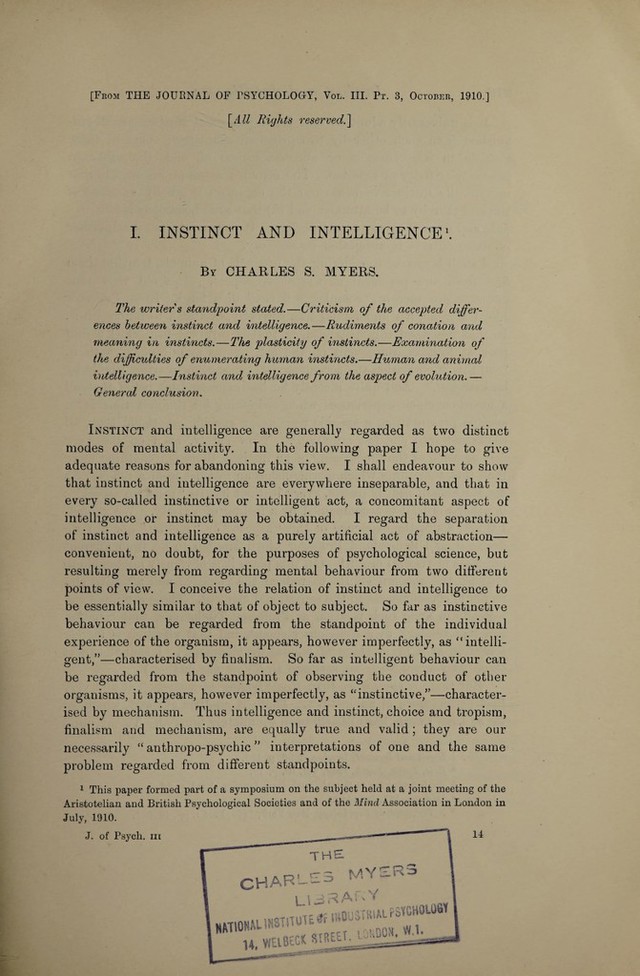
![[From THE JOURNAL OF PSYCHOLOGY, Vol. III. Px. 3, October, 1910.] [All Rights reserved.] I. INSTINCT AND INTELLIGENCE1. By CHARLES S. MYERS. The writer s standpoint stated.—Criticism of the accepted differ¬ ences between instinct and intelligence.—Rudiments of conation and meaning in instincts.—The plasticity of instincts.—Examination of the difficulties of enumerating human instincts.—Human and animal intelligence.—Instinct and intelligence from the aspect of evolution.— General conclusion. Instinct and intelligence are generally regarded as two distinct modes of mental activity. In the following paper I hope to give adequate reasons for abandoning this view. I shall endeavour to show that instinct and intelligence are everywhere inseparable, and that in every so-called instinctive or intelligent act, a concomitant aspect of intelligence or instinct may be obtained. I regard the separation of instinct and intelligence as a purely artificial act of abstraction— convenient, no doubt, for the purposes of psychological science, but resulting merely from regarding mental behaviour from two different points of view. I conceive the relation of instinct and intelligence to be essentially similar to that of object to subject. So far as instinctive behaviour can be regarded from the standpoint of the individual experience of the organism, it appears, however imperfectly, as “ intelli¬ gent,1”—characterised by finalism. So far as intelligent behaviour can be regarded from the standpoint of observing the conduct of other organisms, it appears, however imperfectly, as “instinctive,”—character¬ ised by mechanism. Thus intelligence and instinct, choice and tropism, finalism and mechanism, are equally true and valid; they are our necessarily “ anthropo-psychic ” interpretations of one and the same problem regarded from different standpoints. 1 This paper formed part of a symposium on the subject held at a joint meeting of the Aristotelian and British Psychological Societies and of the Mind Association in London in July, 1910.](https://iiif.wellcomecollection.org/image/b30615446_0003.jp2/full/800%2C/0/default.jpg)