A dictionary of chemical solubilities : inorganic / by Arthur Messinger Comey.
- Comey Arthur Messinger, 1861-
- Date:
- 1896
Licence: Public Domain Mark
Credit: A dictionary of chemical solubilities : inorganic / by Arthur Messinger Comey. Source: Wellcome Collection.
Provider: This material has been provided by the Royal College of Physicians of Edinburgh. The original may be consulted at the Royal College of Physicians of Edinburgh.
30/544 page 6
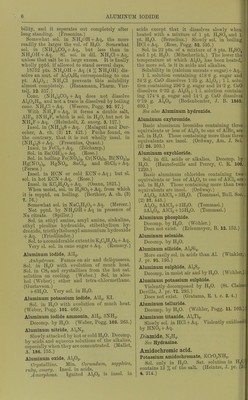
![bility, aiul it separates out completely after long standing. (Fresenius.) Somewhat sol. in NH40H + Aq, the more readily the larger the vol. of H^O. Somewhat sol. in (NH4)oC03 +Aq, but less than in NH^OH + Aq. SI. sol. in dil. NH^Cl + Aq, unless that salt be in large excess. It is finally wholly pptd. if allowed to stand several days. 18752 pts. NH4OH + Aq (4 % NH4OH) dis- solve an amt. of AlaOsHe corresponding to one pt. AI0O3; NH4CI prevents this solubility almost completely. (Hananiann, Pharm. Vier- telj. 12. 527.) Cone. (NH4)2C03 + Aq does not dissolve AlaOgHg, and not a trace is dissolved by boiling cone. NHjCl + Aq. (Weeren, Pogg. 92. 97.) With NH4F + Aq, it forms a double salt, AIF3, 3NH4F, which is sol. in HgO, but not in NH4F + Aq. (Helmholt, Z. anorg. 3. 127.) Insol. in (NH4)2S + Aq. (Malaguti and Dur- oeher, A. eh. (3) 17. 421.) Fuchs found, on the contrary, that it is not wholly insol. in (NH4)2S + Aq. (Fresenius, Quant.) Insol. in FeClj + Aq. (Bechamp.) Sol. in Ba(OH')., + Aq. (Rose.) Sol. in boiling Fe(N03)3, Cr(N0s)3, Bi(N03)3, Hg(N03)2, HgNOg, SnCla, and SbClg + Aq. (Persoz.) Insol. in HON or cold KCN + Aq; but si. sol. in hot KCN + Aq. (Rose.) Insol. in KCoHaOj + Aq. (Osann, 1821.) When moist, sol. in H.jSOg + Aq, from which it is repptd. on boiling. (Berthier, A. ch. (3) 7. 76.) Somewhat sol. in NaCsHjOa + Aq. (Mercer.) Not pptd. by NH40H + Aq in presence of Na citrate. (Spiller.) Sol. in ethyl amine, amyl amine, sinkaline, ethyl picoline hydroxide, stibethylium hy- droxide, triethyltoluenyl ammonium hydroxide + Aq. (Friedliinder.) Sol. to a considerable extentinK2C4H406 +Aq. Very .si. sol. in cane sugar-fAq. (Ramsey.) Aluminum iodide, AII3. Anhydrous. Fumes on ail- and deliquesces. Sol. in HjO with evolution of much heat. Sol. in CS2 and crystallises from the hot sat. solution on cooling. (Weber.) Sol. in alco- hol (Weber); ether and tetra-chlormethane. (Gustavson.) + 6H„0. Very sol. in HoO. Aluminum potassium iodide, AII3, KI. Sol. in H2O with evolution of much heat. (Weber, Pogg. 101. 469.) Aluminum iodide ammonia, AII3, 3NH3. Decomp. by H2O. (Weber, Pogg. 103. 263.) Aluminum nitride, AlgNg. Slowly attacked by hot or cold HgO. Decomp. by acids and aqueous solutions of the alkalies, especially when they are concentrated. (Mallet, A. 186. 155.) Aluminum oxide, AI2O3. Cryslallinc. Min. Corundum, sapphire, ruby, emery. Insol. in acids. Amorphous. Ignited AI2O3 is insol. in acids except that it dissolves slowly when heated with a mixture of 1 pt. H2SO4 and 1 pt. H2O. (Berzelius.) Slowly sol. in boiling HCl-f Aq. (Rose, Pogg. 52. 595.) Sol. in 22 pts. of a mixture of 8 pts. HgSO and 1 pt. H2O. (Mitscherlich.) The lower tli.' temperature at which AI2O3 has been heated, the more sol. is it in acids and alkalies. Solubility in (calcium sucrateH-sugar)+ Aq. 1 1. solution containing 418'6 g. sugar and 34-3 g. CaO dissolves 1-35 g. AI0O3; 1 1. solu- tion containing 296 '5 g. sugar and 24 '2 g. CaO dissolves 032 g. AUOg; 1 1. solution contain- ing 174'4 g. sugar and 141 g. CaO dissolves 0-19 g. AI0O3. (Bodenbender, J. B. 1865. 600.) See also Aluminum hydroxide. Aluminum oxybromide. Basic aluminum bromides containing three equivalents or less of AljOg to one of AlBij are sol. in H2O. Those containing more than three equivalents are insol. (Ordway, Am. J. Sci. (2) 26. 203.) Aluminum oxycMoride. Sol. in dil. acids or alkalies. Decomp. by H2O. (Hautefeuille and Perrey, C. R. 100. 1220.) Basic aluminum chlorides containing two equivalents or less of AI2O3 to one of AICI3 are sol. in H2O. Those containing more than two equivalents are insol. (Ordway.) AI2O3, 3AlCl3-f 3H„0. (Tommasi, Bull. Soc. (2) 37. 443.) AI2O3, 8AlCl3-f3H20. (Tommasi.) 3AI2O3, AICI3 + 15H2O. (Tommasi.) Aluminum phosphide. Decomp. by H2O. (Wohler.) Does not exist. (Erlenmeyer, B. 12. 152.) Aluminum selenide. Decomp. by HjO. Aluminum silicide, A]2Si4. More easily sol. in acids than Al. (Winkler, J. pr. 91. 193.) Aluminum sulphide, AI2S3. Decomp. in moist air and by H2O. (Wohler.) Aluminum potassium sulphide. Violently decomposed by HjO. (St. Claii'e Deville, J. pr. 71. 293.) Does not exist. (Gratama, R. t. c. 3. 4.) Aluminum telluride. Decomp. by H2O. (Wohler, Pogg. 11. 160.} Aluminum titanide, Al3Ti2. Slowly sol. in HCl-l-Aq. Violently oxidised by HN03-1-Aq. Di&mide, N2H4. See Hydrazine. Amidochromic acid. Potassium amidochromate, KCrOgNHa. Sol. only in H2O. Sat. solution in HjC contains 13 % of the salt. (Heiutze, J. pr. (2- 4. 214.)](https://iiif.wellcomecollection.org/image/b21713613_0030.jp2/full/800%2C/0/default.jpg)
 No text description is available for this image
 No text description is available for this image
 No text description is available for this image