Report of the Health Officer, Corporation of Madras Health Department.
- Madras (India). Health Department
- Date:
- [1925]
Licence: Public Domain Mark
Credit: Report of the Health Officer, Corporation of Madras Health Department. Source: Wellcome Collection.
12/244 (page 4)
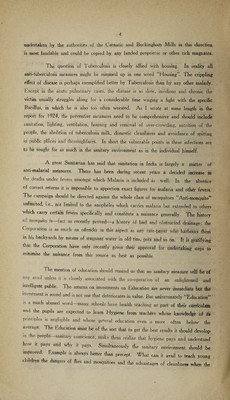
![undertaken by the authorities of the Carnatic and Buckingham Mills in this direction is most laudable and could be copied by any landed proprietor or other rich magnates. The question of Tuberculosis is closely allied with housing. In reality all anti-tuberculosis measures might be summed up in one word “Housing”. The crippling effect of disease is perhaps exemplified better by Tuberculosis than by any other malady. Except in the acute pulmonary cases, the disease is so slow, insidious and chronic the victim usually struggles along for a considerable time waging a fight with the specific Bacillus, in which he is also too often worsted. As I wrote at some length in the report for 1924, the preventive measures need to be comprehensive and should include sanitation, lighting, ventilation, housing and removal of over-crowding, nutrition of the people, the abolition of tuberculosis milk, domestic cleanliness and avoidance of spitting in public places and thoroughfares. In short the vulnerable points in these infections are to be sought for as much in the sanitary environment as in the individual himself. A great Sanitarian has said that sanitation in India is largely a matter of anti-malarial measures. There has been during recent years a decided increase in the deaths under fevers amongst which Malaria is included as well. In the absence cf cotrect returns it is impossible to apportion exact figures for malaria and othdr fevers. The campaign should be directed against the whole class of mosquitoes “Anti-monquito” unlimited, i.e., not limited to the anopheles which carries malaria but extended to others which carry certain fevers specifically and constitute a nuisance generally. The history c: mosquito is—fact as recently proved—a history of bad and obstructed drainage; the Corporation is as much an offender in this aspect as any rate-payer who harbours them in his backyards by means of stagnant water in old tins, pots and so on. It is gratifying that the Corporation have only recently given their approval for undertaking steps to minimise the nuisance from this source as best as possible. The mention of education should remind us that no sanitary measure will be of any a\ad unless it is closely associated with the co-operation of an enlightened and intelligent public. The returns on investments on Education are never immediate but the investment is sound and is not one that deteriorates in value. But unfortunately “Education” 13 d mUch abused word“:many schools have health teaching as part of their curriculam ana the pupils are expected to learn Hygiene from teachers whose knowledge of its principles is negligible and whose general education even is more often below the average. The Education must be of the sort that to get the best results it should develop m ** peop]e~''5anitary conscience, make them realise that hygiene pays and understand how it pays and why it pays. Simultaneously the sanitary environment should be improved. Example is always better than precept. What can it avail to teach young children the dangers of flies and mosquitoes and the advantages of cleanliness when the](https://iiif.wellcomecollection.org/image/b31484748_0012.jp2/full/800%2C/0/default.jpg)