On the archetype and homologies of the vertebrate skeleton / by Richard Owen.
- Richard Owen
- Date:
- 1848
Licence: Public Domain Mark
Credit: On the archetype and homologies of the vertebrate skeleton / by Richard Owen. Source: Wellcome Collection.
Provider: This material has been provided by King’s College London. The original may be consulted at King’s College London.
42/238 (page 30)
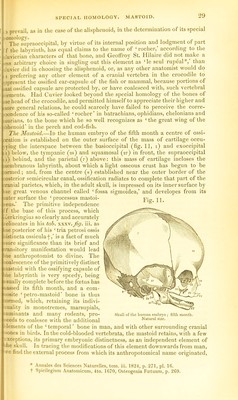
![Partially disarticulated cranium of the Echidna setosa. Natural size, I It is ini)3ortant to keep these essential characters steadily in view,and toavoid giving undue importance to the apophysial character of the mastoid, which has. led to so common a transference of its name, in the great osteological works of Cuvier and De Blainville, to a quite distinct element (paroccipital) of the I cranial wallsf. It is necessary, also, to be prepared for that change of the * The continuators of Cuvier make mention of an example of this kind and propose the name of ‘ paramastoid ’ for the proeess (Le9ons d’Anat. Corap. ii. (1837) p. 312). I have observed it in the skull of a New Zealander and in that of an Irishman, preserved in the Museum of Anatomy in Richmond Street, Dublin. Believing it to be the homologue of the ‘ paroccipital ’ (4), which is developed independently in chelonia and most fishes, I retain that name for it: it must not be confounded with that angle of the occipital which projects into the ‘ foramen jugularc ’ in the human skull, and which has received the name of ‘ processus jugularis,’ in some systems of anthropotomy. t How essential a correct view of special homology becomes to the appreciation of the inconstant, its functions being transferred in many mammals to another pre cess, sometimes udder-shaped, sometimes of great length (tig. 24“, 4), bu which is developed from the exoccipital, and is represented in the human sku ,| by the ‘ eminentia aspera,’ &c. of Soemmerring (Table I. 4), and by the “sce: brous ridge extended from the middle of the condyle towards the root of th mastoid process” of Munro {op. oil. p. 72); but sometimes also here deve loped, as a rare anomaly, on one or both sides, into a process like a seconc but smaller posterior mastoid*. The more constant and essential character' of the mastoid are its contribution to the walls of the acoustic chamber carried to anchylosis with the petrosal in birds and mammals, and its sutura] connection in the latter with the exoccipital, parietal, and squamosal (tin squamo-mastoid suture becoming obliterated in many species, e. g. the hog. fig. 24, 8, 27): it is also grooved, notched or perforated by a greater or lesJ proportion of the lateral venous sinus, whether this is continued to the ‘fora men jugulare,’ as in man, or sends a large division to escape by the ‘ meatu: | temporalis ’ which forms the lai’ge orifice between the mastoid and squamosai above the meatus auditorius in the horse and ruminants, and which directlj' perforates the mastoid in the echidna (fig. 12, ni). W Fig. 12.](https://iiif.wellcomecollection.org/image/b21307830_0042.jp2/full/800%2C/0/default.jpg)