On the archetype and homologies of the vertebrate skeleton / by Richard Owen.
- Richard Owen
- Date:
- 1848
Licence: Public Domain Mark
Credit: On the archetype and homologies of the vertebrate skeleton / by Richard Owen. Source: Wellcome Collection.
Provider: This material has been provided by King’s College London. The original may be consulted at King’s College London.
52/238 (page 40)
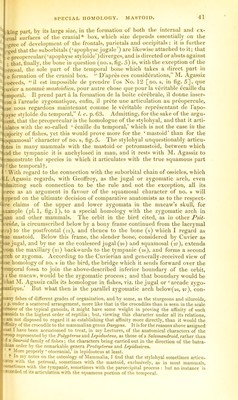
![In urging a reconsideration of the value and significancy of these chi A ters, I may repeat that in mammals the mastoid constantly presents t:l whilst the squamosal very rarely has the first, and not often the second L raeter. It must also be remembered that the squamosal loses its connecMi with the frontal and progressively decreases in the mammalian class to less ■: the dimensions of the mastoid itself, as e. g. in echidna (fig. 12), whilst in ft monotreme the mastoid, s, besides its connections with the parietal and extft pital, extends forwards to articulate with the alisphenoid, e. If ossificaft were restricted in mammals to no. s, fig. 11, in reference to lo, whichft^ mained cartilaginous, then no. s would have the same relation to the otocrft or in other words, would contribute the same protection to thq acoustic li.^ rintli, which no. s, fig. 5, performs in fishes; the external semiciraji ■ canal at least would be protected by the mastoid in both : only in maminft the mastoid would also extend over the posterior canal. The petrosal 1 ft no part of its essential character as the capsule or outer t\inic of the h ft rinth by becoming ossified, nor is it less recognisable in fishes within ft mastoid, by remaining membranous or cartilaginous, than is the sclerft capsule of the eye in its chamber or orbit; which capsule, in like man ft presents all the corresponding histological modifications in one or other ]ft of the vertebrate series. The mask which has concealed the true featureTt- resemblance of the human mastoid to that of fishes, is simply the petr< ossified and cemented to it. But the squamosal presents no such relation: the bony capsule of the semicircular canals in any mammal. Even connection of the squamosal with the tympanic bone is, as we have seen,, less constant and intimate in mammals than the connection of the mast with the tympanic*. In the anatomical description of the existing ganoid fishes which Agassiz has unfortunately called ‘ Sauroidf,’ the bone no. s is described * From the remark in p. 53, t. ii. pt. ii. ‘ Recherches sur les Poiss. Foss.,’ it would st that the circumstance of the extension of the tympanic air-cells into the mastoid, in cerr mammalia, had weighed with M. Agassiz in determining its homological characters. t All the characters by which these highly organized fishes approximate the Reptilia i found, not in the highest, but in the lowest order of tliat class, viz. in the batrachia, and her more especially in the salamanders. The air-bladder of Lepidostem resembles the lung the serpent in its singleness, and those of the salamander in the degree of its cellulari' some parts of the structure being peculiarly piscine. The bifid air-bladder of Polypte> resembles the lungs of the salamandroid menopome and proteus, in the want of celli walls. The characteristic large bulbus arteriosus and its numerous rows of valves, wh distinguish the ganoids from most other osseous fishes, are retained in the menopome, 1 are not present in any saurian. The anterior ball and posterior cup of the vertebrae of. pidostem are repeated in the salamander and pipa, but in no existing saurian. The lal rinthodont character of the teeth of Lepidosteus was developed to its maximum in the gr.- extinct reptiles {Salamandrdides, Jager), which, by their double occipital condyle, der, gerous double vomer, and biconcave vertebrae, were essentially Batrachia, not Sauria\ a which combined characters now found only in the lower salamandroid Batrachia, with den' ones borrowed from fishes, and but feebly manifested by the most fish-like of sauria {Ichthyosaurus). All the so-called sauroid fishes retain the characteristic piscine articu concavity on the basioccipital for the atlas : it is, however, very shallow in the pobTitenit and is also extended transversely, with the lateral borders or angles so prominent, that, : M. Agassiz well remarks, “ it needs very little to change this transverse articulation with two lateral ridges into two distinct articular condyles,” /. c. p. 71. But this would conve pro tanto, the polypterus into a hatrachian, not into a saurian. So far as the character oB single convex occipital condyle is valuable as a mark of affinity to the Sauria, it is \neses in a fish of a different order from the ganoids, and with much fewer approximations in oth' respects to the reptilian class, viz. in the Fistularia tahaccaria. There remains, therefoi i only the character of the enamelled scales which the polypterus and lepidosteus present common with all the lower organized ganoids, and which to a certain extent resemble tl bony scutes of the crocodilia. If the deposition of calcareous matter in and upon the sk were not essentially a retention of a very low type of skeleton ; if it were not presented 1 <](https://iiif.wellcomecollection.org/image/b21307830_0052.jp2/full/800%2C/0/default.jpg)