Parasitic worms, with a note on a free-living nematode / by R.T. Leiper and E.L. Atkinson.
- Leiper, Robert Thomas, 1881-1969.
- Date:
- 1915
Licence: In copyright
Credit: Parasitic worms, with a note on a free-living nematode / by R.T. Leiper and E.L. Atkinson. Source: Wellcome Collection.
Provider: This material has been provided by London School of Hygiene & Tropical Medicine Library & Archives Service. The original may be consulted at London School of Hygiene & Tropical Medicine Library & Archives Service.
25/76 (page 35)
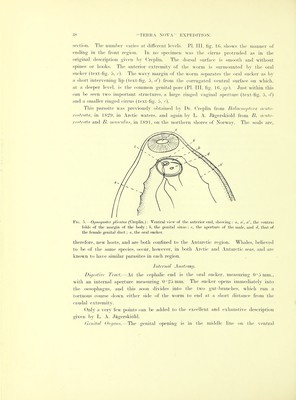
![Parasite.—Most of the .specimens appear comma-shaped, owing to the ventral bending of the anterior portion of the body. The worms taper considerably in front, having their greatest width at the level of the yolk-glands, where the body becomes thick and almost cylindrical. The posterior end is very bluntly rounded. The excretory pore lies at the base of a small dimple. There is no abdomen, nor does the skin appear to be striated, although on the ventral aspect irregular rugae are seen, apparently attributable to the bending of the specimen. The oral sucker (PI. Ill, tig. IS, n) is about half the size of the ventral sucker (/>). The suckers vary considerably in shape and in the thickness of the muscular wall in different specimens. This is due to varying amounts of contraction. A characteristic feature of the oral aperture is a fleshy lip extending around the dorsal but absent from the ventral rim. The pharynx is small and globular. The main gut-branches (</) are greatly dilated. They extend to the posterior end of th • body, where they are almost contiguous. The yolk-glands (//. //') consist of two half-moon-shaped solid masses lying in apposition, one anterior to the other. The ovary (ov.) is smooth and oval, with the posterior aspect somewhat indented by the yolk-gland. The testes (t, /') are compact rounded bodies K ing slightly diagonally to one another, immediately in front of the ovary. The eggs as seen within the uterus (at) measure <)'04 mm. by 0'02 mm., and are brownish in colour. LEPOCREADIINAE. Lepodora, Odhner, 1905. IT). Lepodora, garrardi, Leip. and Atk. (PI. Ill, fig. 20.) Lepodora garrardi, Leiper and Atkinson, Proc. Zool. Sac., 1914, p. 224. Flat fleshy forms •> nun. by 0'9 nun. Colour brownish, due to numerous yolk-glands. Skin covered with delicate spines. Ventral sucker 0-27 nun., oral sucker (.(-37 nun. Stout pyriform pharynx, 0*2 mm. tiggs few but large. Testes tandem. Gut-branches wide and extending to the. posterior end of the 1 lody. Host. Two specimens from the intestine oi Trematomuft beviuwchu. Parasite. Plat fleshy forms, 3 nun. by 09 mm., of a brownish colour, apparently due to the large and numerous yolk-glands, which extend from the level of the bifurcation of the gut to the posterior end oi the body, and inwards also to unite across the body. Delicate spines occur on the skin. The ventral sucker (PL III, tig. 20, />), 027 mm. in diameter, is slightly smaller than the oral sucker (<i). and lies at the junction of the anterior and middle third of the body. The oral sucker. ()'.>7 mm. in diameter, opens subterminally. There is a prepharynx and a stoutly developed pvriform muscular pharynx, 0'2 mm., succeeded by a slender oesophagus. The two gut-branches (7) are of wide lumen and reach to within 0*] nun. of the excretory opening. The genital orifice ((/p) lies immediately in front of the ventral sucker and is unusuallv obvious. The cirrus is short and fleshy. The globular testes (/. /') lie tandem, and immediatelv in front of them, and sliojhtlv to one side oi the middle line, is a laroe](https://iiif.wellcomecollection.org/image/b21356622_0025.jp2/full/800%2C/0/default.jpg)