Improvements in apparatus for the electrotherapeutic treatment of the human body.
- Simpson, Dundas
- Date:
- 1930
Licence: Public Domain Mark
Credit: Improvements in apparatus for the electrotherapeutic treatment of the human body. Source: Wellcome Collection.
2/4 page 2
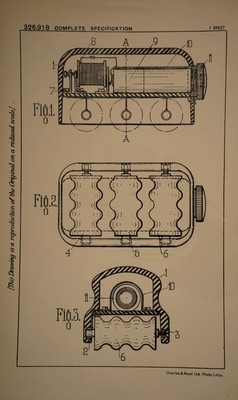
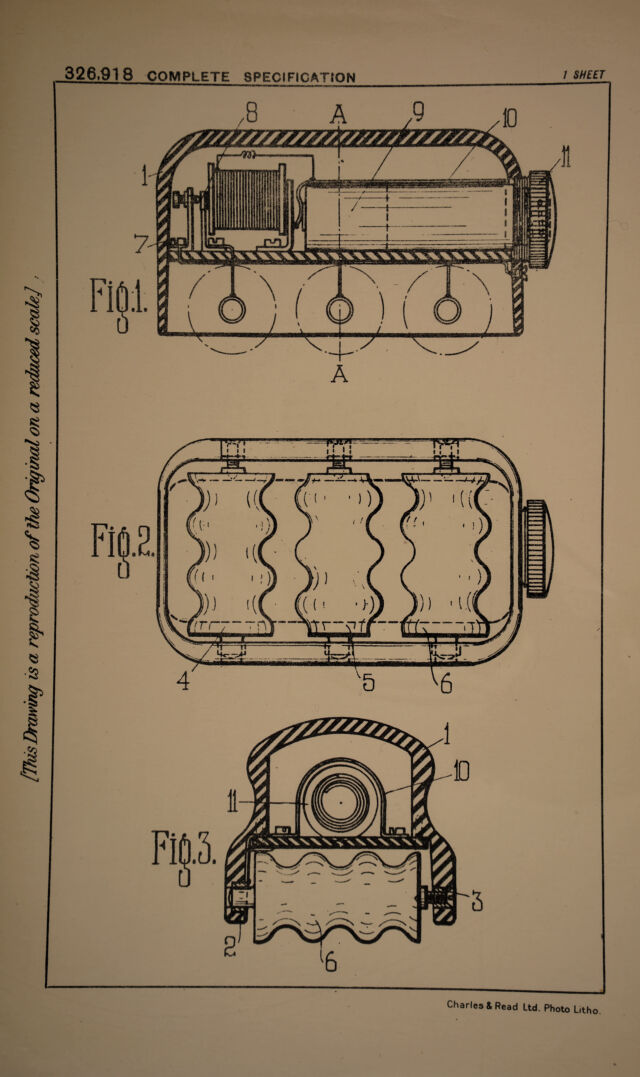
![326,918 2 u f a handle enclosing an induction coil, pro¬ vided with an automatic make and break, and a roller or rollers having a knobbed spiral or irregular surface, mounted on 5 and insulated from the said handle and in circuit with the said coil. The invention is more particularly described with reference to the accom¬ panying drawings in which.:— jq Figure 1 is a sectional elevation of one form of construction. Figure 2 is a bottom plan view. Figure 3 is a corresponding end sec¬ tional viewr. ak A casing 1 is provided with bearings 2, 1 3, one of which may be adjustable to receive a number of rollers 4, 5, 6. These rollers are insulated from the casing 1 where this is of metal, but normally it 20 will be preferred to make the casing 1 of a moulded plastic material, such as a phenol condensation product or the like, which has insulating properties. The two outer rollers 4, 6, are con- 25 nected to a terminal 7 of a trembler coil 8, the primary circuit of which includes a dry cell 9 which may be interchange¬ able with the ordinary pocket flash lamp cel]. This cell can be received within a 30 small sheet metal casing 10 mounted within the casing 1, and is accessible by means of a detachable knurled cap 11. This knurled cap can be screwed in to force the dry cell against internal con- 35 tacts, thus closing the circuit through the primary of the induction coil, which may be formed as a switch head controlling this primary circuit. It will consequently be seen that when- 40 ever the article is applied to the surface of the human body, a high frequency cur¬ rent will pass from the centre roller 5 through the body to rollers 4, 6, complet¬ ing the circuit through the secondary of 45 the induction coil. The casing 1 is preferably moulded as shown to form a convenient hand grip. The rollers 4, 5, 6, may be parallel sided, but preferably will be provided wuth concave and convex grooves, and 50 flanges, respectively as shown. These rollers may be of aluminium ot again may be of dissimilar metal, certain of the rollers being more electropositive than others. && In the arrangement above shown, three separate rollers are used. In a modified form of construction, a single roller may be used formed of a number of separate sections insulated from one another, each 60 pair of sections being arranged in circuit with an induction coil. Having now particularly described and ascertained the nature of my said inven¬ tion and in what manner the same is 65 to be performed, I declare that what I claim is:— 1. An improved apparatus for the treatment of the human body comprising a handle enclosing a dry cell, and an 70 induction coil provided with an auto¬ matic make and break, and a roller or rollers having a knobbed, spiral, or irregular surface mounted on and insu¬ lated from the said handle and in circuit 75 writh the said coil. 2. An improved apparatus for tne treatment of the human body as claimed in claim 1 in which each roller is formed of a number of separate sections insulated 80 from one another the circuit being com¬ plete by a part of the human body short¬ ing two sections. 3. An apparatus for the treatment of the human body as claimed in claim 1 85 in which the handle is of insulated material and partly enshrouds the rollers. 4. An apparatus for the treatment of the human body constructed and arranged to operate substantially as described with 90 reference to the accompanying drawings. Dated this 29th day of June, 1929. W. P. THOMPSON & Co., 12, Church Street, Liverpool, Chartered & Registered Patent Agents. Redhill: Printed for His Majesty’s Stationery Office, by Love & Malcomson, Ltd.—1930. pat C&-3 / 9 3 CP. 3Z6 8 22503478732](https://iiif.wellcomecollection.org/image/b30759663_0002.jp2/full/800%2C/0/default.jpg)