Report of the Departmental Committee appointed to inquire into the dangers attendant on the use of lead and the danger or injury to health arising from dust and other causes in the manufacture of earthenware and china; and in the processes incidental thereto, including the making of lithographic transfers.
- Home Office
- Date:
- 1910
Licence: In copyright
Credit: Report of the Departmental Committee appointed to inquire into the dangers attendant on the use of lead and the danger or injury to health arising from dust and other causes in the manufacture of earthenware and china; and in the processes incidental thereto, including the making of lithographic transfers. Source: Wellcome Collection.
Provider: This material has been provided by London School of Hygiene & Tropical Medicine Library & Archives Service. The original may be consulted at London School of Hygiene & Tropical Medicine Library & Archives Service.
102/312 page 88
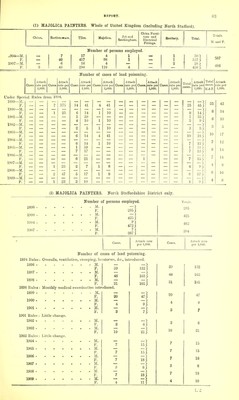
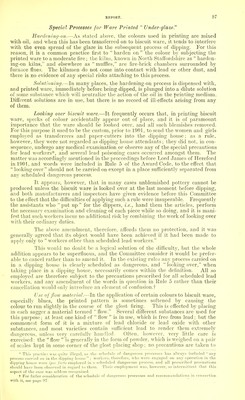
![prevent it from being blown about the workplace, and it is usually put into the saggers in open cups. In one or two large works this old method has happily been superseded, the tendency of the flow' to disperse dust being greatly reduced by mixing the powder with a plastic material. Further to mitigate the danger, it was advocated that separate rooms should be provided for the preparation and weighing out of flow materia], and that these operations should be included in the schedule of dangerous processes, in order that the workers engaged in them shall be periodically examined and be made subject to all the other regulations which apply to such scheduled lead workers as millers and mixers of glazes. The Committee do not feel that they are in a position to suggest that the use of flow-in the cake or plastic form should be made compulsory; but they strongly recommend it as safer than the powder. Where the latter is used, it should be most carefully handled, weighed out in the lead-house into standard-sized cups, and delivered to the glost placers with every precaution to prevent dust being scattered from it. The Committee propose the following rules for all places where a flow material containing lead is used:— A male adult shall be specially appointed to weigh out flow material and deliver it to the glost placers. The rules recommended for the handling of raw lead compounds in the lead-house shall apply. The processes of weighing out or preparing flow material shall be included in the schedule of dangerous processes, and shall be carried on in front of an efficient exhaust opening. Special Processes for On-glaze Printed Ware. All colours applied to ware after it has been glazed, must be fixed by an additional firing. For this purpose kilns are used similar to those employed for the hardening-on process, and the colours for on-glaze work being described as enamels, they are usually known as enamel kilns. In a few cases, notably when cobalt blue is used, a greater heat is required than such kilns can produce, and the ware after decoration has therefore to be put a second time through' the glost oven. In all such colours there is generally a considerable proportion of a lead flux, but there is no record of any lead poisoning having ever occurred among the enamel kilnmen. This firing, therefore, and the operations incidental to it, may be regarded as free from special risk. 2. Painting. Paints are applied to ware, both under the glaze and upon it, with brushes and similar implements.* But whether the ware is painted in the biscuit or glost state, there is no evidence of any specific illness resulting from the' operation. It is true that the on-glaze or enamel colours, as mentioned on page 85, usually contain a considerable amount of lead, but they are mixed with an oily medium, and hence the splashes which may fall on work benches or floors, dry very slowly, and do not give rise to dust. 3. Ground Laying. This process, which is often locally known as oil and dusting, is in practice confined to on-glaze decoration. A pattern or back-ground is first painted on white glazed ware, whether earthenware or china, with an oily medium, and dry powdered enamel colour is dusted over it with a pad of cotton-wool; the colour adheres where- ever the medium has been applied, and any falling elsewhere on the ware is removed by wiping with a piece of clean cotton-wool or other suitable material. Considerable risk is involved in the use of powdered colours rich in lead, and in 1898 exhaust fans were made compulsory wherever this process was carried on. The result of improved conditions is very clearly shown by the subjoined figures: — *The term biscuit or under-glaze painting is held to include sponge-work, which is a special method of decoration employed in the manufacture of cheap earthenware, such as that known in the trade as Persian painted ; in this process a hard sponge is used, which is cut into the shape of a leaf or flower or other simple design, and the colour, mixed with water or oil, dabbed with it on to the b'scuit ware.](https://iiif.wellcomecollection.org/image/b21353049_0102.jp2/full/800%2C/0/default.jpg)
 No text description is available for this image
 No text description is available for this image
 No text description is available for this image