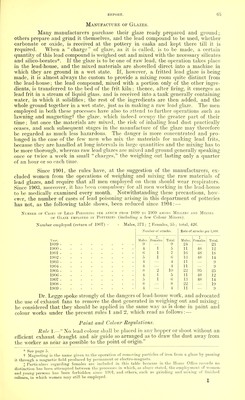
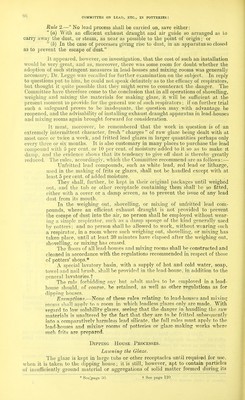
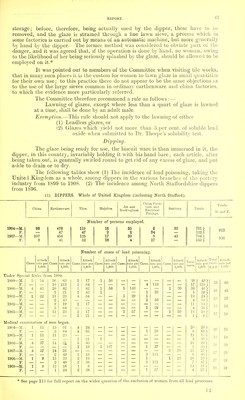
Report of the Departmental Committee appointed to inquire into the dangers attendant on the use of lead and the danger or injury to health arising from dust and other causes in the manufacture of earthenware and china; and in the processes incidental thereto, including the making of lithographic transfers.
- Home Office
- Date:
- 1910
Licence: In copyright
Credit: Report of the Departmental Committee appointed to inquire into the dangers attendant on the use of lead and the danger or injury to health arising from dust and other causes in the manufacture of earthenware and china; and in the processes incidental thereto, including the making of lithographic transfers. Source: Wellcome Collection.
Provider: This material has been provided by London School of Hygiene & Tropical Medicine Library & Archives Service. The original may be consulted at London School of Hygiene & Tropical Medicine Library & Archives Service.
82/312 page 68
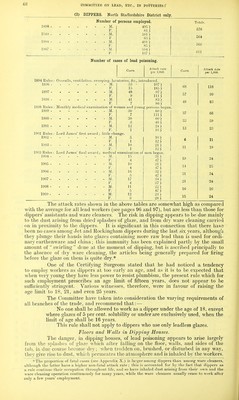
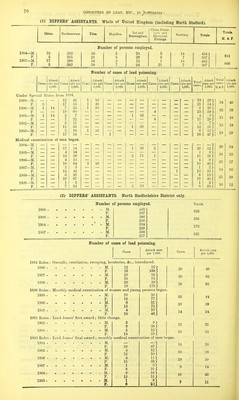
![(2) DIPPERS. North Staffordshire District only. 1898 1900 1904 1907 Number of persons employed. - M. F. . M. F - M. F. M. F. 495 ■) 815 501! 63 j 481 ) 85 j 504 \ 107 ) Totals. 576 564 566 611 Number of cases of lead poisoning. Cases. Attack rate pei I,0u0. Cases. Attack rate per 1,000. 1894 Rules: Overalls, ventilation, sweeping, lavatories, &c, introduced. 1896 M. 53 • 107) 185) 97? 1115 83 86 1897 M. F. M. F. M. F. 53 15 48 9 41 7 1898 Rules : Monthly medical examination of women and young persons began. 1899 1900 1901 1901 Rules 1902 - 1903 - 1903 Rules 1904 - M. F. M. F. M. F. Lord James' first award ; little change. - - - - - M. F. M. F. Lord James' final award ; medical examination of men began. 30 7 30 3 12 1 1 10 1 60) 111] 60 | 48) 165 8} 1905 1906 1907 1908 1909 M. F. M. ]•'. M. F. M. F. M. F. M. F. 15 4 10 4 16 11 5 12 3 31 \ 47 5 21) 47 5 32) 47 5 m 3} 68 57 48 37 33 13 6 11 19 14 21 21 16 15 118 99 66 59 23 11 19 34 25 34 34 26 24 The attack rates shown in the above tables are somewhat high as compared with the average for all lead workers (see pages 96 and 97), but are less than those for dippers' assistants and ware cleaners. The risk in dipping appears to be due mainly to the dust arising from dried splashes of glaze, and from dry ware cleaning carried on in proximity to the dippers. It is significant in this connection that there have been no cases among Jet and Rockingham dippers during the last six years, although they plunge their hands into glazes containing more raw lead than is used for ordi- nary earthenware and china; this immunity has been explained partly by the small amount of swirling done at the moment of dipping, but is ascribed principally to the absence of dry ware cleaning, the articles being generally prepared for firing before the glaze on them is quite dry.* One of the Certifying Surgeons stated that he had noticed a tendency to employ workers as dippers at too early an age, and as it is to be expected that when very young they have less power to resist plumbism, the present rule which for such employment prescribes an age limit of fifteen years, does not appear to be sufficiently stringent. Various witnesses, therefore, were in favour of raising the age limit to 18, 21, and even 25 years. The Committee have taken into consideration the varying requirements of all branches of the trade, and recommend that: — No one shall be allowed to work as a dipper under the age of 18, except where glazes of 5 per cent, solubility or under are exclusively used, when the limit of age shall be 16 years. This rule shall not apply to dippers who use only leadless glazes. Floors and Walls in Dipping Houses. The danger, in dipping houses, of lead poisoning appears to arise largely from the splashes of glaze which after falling on the floor, walls, and sides of the tub, in due course become dry; when trodden on, brushed, or disturbed in any way, they give rise to dust, which permeates the atmosphere and is inhaled by the workers. *The proportion of fatal cases (see Appendix X.) is larger among dippers than among ware cleaners, although the latter have a higher non-fatal attack rate ; this is accounted for by the fact that dippers as a- rnle continue their occupation throughout life, and so have inhaled dust arising from their own and the ware cleaning operation continuously for many years, while the ware cleaners usually cease to work after only a few years' employment.](https://iiif.wellcomecollection.org/image/b21353049_0082.jp2/full/800%2C/0/default.jpg)
 No text description is available for this image
 No text description is available for this image
 No text description is available for this image