Ancient art and its remains, or, A manual of the archaeology of art / By C.O. Müller.
- Karl Otfried Müller
- Date:
- 1852
Licence: Public Domain Mark
Credit: Ancient art and its remains, or, A manual of the archaeology of art / By C.O. Müller. Source: Wellcome Collection.
118/664
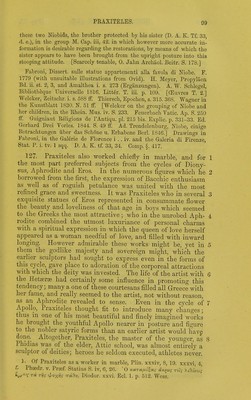
![1. Par htesitatio est in templo ApoUinis Sosiani, Nioben cum liberis morientem (or Niobao liberos morientes) Scopas an Praxiteles feceric, Plin. xxxvi, 4, 8. The epigrams pronounce for Praxiteles (Anthol. Paf. App. ii. p. 664. Plan, iv, 129. Auson. Epit. Her. 28). The temple of Apollo Sosianus was probably founded by C. Sosius who was under An- toninus in Syria (com. Dio. Cass, xlix, 22, with Plin. xiii, 11). [Wagner S. 296.] As to the group having been placed on a pediment (according to Bartholdy's idea), see Guattani, Memorie Enciclop. 1817. p. 77, and Le statue della favola di Niobe sit. nella prima loro disposizione, da C. R. CockereU. P. 1818, also (Zannoni) Galeria di Firenze, Stat. P. ii. tv. 76. [Wagner disputes this.] Thiersch doubts it, but nevertheless gives to the group the triangular form and bilateral disposition. [Not the trian- gular form, S. 369. comp. 273.] 4. To the Florentine group (found at Rome in 1583 near the gate of S. Giovanni) many unsuitable figures have been added (a discobolus, a Psyche, a muse-like figure, a nymph, a horse). The group of youthful pancratiasts likewise, although found hard by, does not fit well into the whole, but seems to have been executed after the symplegma of Cephisso- dotus, the son of Praxiteles (digitis verius corpori quam marmori impres- sis, Plin.) [1]. But even the rest of the statues are of unequal merit, nay of different marble. Of the Niobids at Florence, besides the mother with the youngest daughter, ten figures may be held as genuine, and (conformably to the remark of Thorwaldsen) the so-called Narcissus (Galeria tv. 74) may be added to them. It is still very doubtful whether the Florentine figures are those which were famous in antiquity, as the treatment of the bodies, although in general excellent and grandiose, does not however display that uniform perfection and living freshness which characterized the works of the Greek chisel at the best period.—On the contrary the breathing Ufe of Greek art cannot but be recognised in the so-caUed lUoneus in the Glyptotheca at Munich (no. 125); though worthy of a Scopas, it cannot however receive an entirely satisfactory explanation from a union with the Niobids. Comp. Kunstblatt 1828. No. 45. The so- called Niobid at Paris (L. 441. Clarac, pi. 323), is more probably a Maenad struggling away from a Satyr. Of the authentic figures in the group, out of Florence the sublime head of the mother (very fine in Sarskoselo and in Lord Yarborough's coUection) and the dying outstretched son (also at Dresden and Munich) are most frequently to be met with. 5. Besides the mother, the following partial groupings are indicated: a The pfedagogue (Gal. 15) was so placed beside the youngest son (Gal. 11) that the latter pressed towards him on the left side while he drew bim to himself with the right arm, according to the group found at Soissons, which is copied (with a confounding of right and left) m R. Rochette M. I. pi. 79. comp. p. 427. b. A son (Gal. 9) supported, with his left foot advanced under her sinking form, a dying sister,—who is preserved in a group in the Vatican, called Cephalus and Procris,— and endeavoured to shield her by spreading his garment over her; ac- cording to the observations of [Canova], Schlegel, Wagner, and Thiersch (Epochen, s. 315). c. A daughter (Gal. 3) in like manner tried with out- spread upper-garment to protect the son who is sunk on his loft knee (Qa\ 4 Race 33) ; a group which can be recogmsed with certainty from i lalJ gem-Ur;;ing^Im'pron^ gemm. d. Inst, i, 74). I also recogmsr-](https://iiif.wellcomecollection.org/image/b2178016x_0118.jp2/full/800%2C/0/default.jpg)