Ancient art and its remains, or, A manual of the archaeology of art / By C.O. Müller.
- Karl Otfried Müller
- Date:
- 1852
Licence: Public Domain Mark
Credit: Ancient art and its remains, or, A manual of the archaeology of art / By C.O. Müller. Source: Wellcome Collection.
271/664
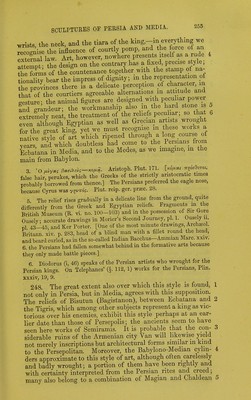
![Hirt in the Abhandl. der BerUner Acad. 1820. s. 40. [Voy. en Perse de M. Flandin, peintre, et de M. Coste, architecte. P. 1845. The drawmga are after Steuart, who Uved many years in Persia, remarkably true m character.] 5 A broad double stair led to three gates adjoining one another ; these to the double pillars with the colossal haut-reUefs of imaginary ani- mals. A second flight was then ascended to the palace strictly so-called. Three porticoes surrounded a larger one without separation by walls; it is probable they were only divided by tapestries (Esther i, 6) which were suspended along the columns, as in Alexander's state-tent (^liau V. H. ix, 3) and the Dionysian tent of Ptolemy the Second (§. 150, 2). The inner rooms and chambers now lie apart from these, on the highest terrace; here also columns in the chief apartment. These chambers, however, certainly formed at one time a connected building with those porticoes. Lower subordinate erections, among them one tolerably ex- tensive Extent of the whole 1400 X 900 feet. The impression which the entire edifice must have made is best conveyed in the admirable descrip- tion of a Persian residence in Appuleius De Mundo, p. 270. Bip. (Ps. Aristot. De Mundo, c. 6); especiaUy the foUowing portion: (Rex) cir- cumseptus admirabili regia, cujus tecta fulgerent eboris nive, argenti (§. 243) luce, flammea auri vel electri claritate: limina vero aha prae aliis erant, interiores fores, exteriores januae muniebant portseque ferratse et muri adamantina firmitate. 6. The columns (see particularly Porter, pi. 45) of the grand portico 65 feet high, about 4 feet thick at the bottom, with Ionic flutings and high bases of a peculiar form; the capitals sometimes composed of the fore- parts of unicorns, sometimes of a great variety of oddly combined ingre- dients (an inverted crater, another placed upright upon it, and on that again a high abacus with two rows of scrolls at the four sides). ^ Be- sides, ornaments of foliage, roses, volutes, and astragals. On the king's sepulchre also appear the dentels, a sort of ovolo with serpent-tongues and the architrave with three fasciae. The cornices over the doors bear some resemblance to those of Egyptian architecture (§. 222). The square blocks and the portions of the columns are wrought and fitted together in a manner that excites admiration. There are traces of water-conduits through the porticoes and apartments. Chardin and Morier mention enigmatical subterranean passages. 24)5. The sepulchral monuments also of the Achamenida 1 were in this ancient seat of the race. These were rarely 2 buildings standing apart like that of Cyrus; more commonly 3 they consisted of facades hewn out of the rocks, with secret and inaccessible chambers behind, such as are to be found partly on the wall of rock above the palace of Persepolis already described, and partly northward from it at Nakshi- Rustan. The architecture presents the same forms as at Per- 4 sepolis; the prevailing representation is that of a stage upon which the king appears, engaged in some religious rite, above a frieze and architrave which are supported by columns with unicorn capitals.](https://iiif.wellcomecollection.org/image/b2178016x_0271.jp2/full/800%2C/0/default.jpg)