Ancient art and its remains, or, A manual of the archaeology of art / By C.O. Müller.
- Karl Otfried Müller
- Date:
- 1852
Licence: Public Domain Mark
Credit: Ancient art and its remains, or, A manual of the archaeology of art / By C.O. Müller. Source: Wellcome Collection.
590/664 page 572
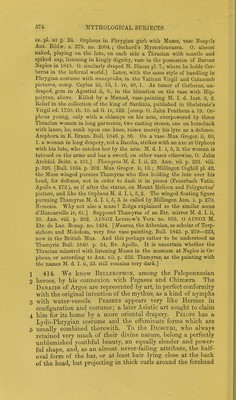
![5. Medea's destinies. Bottiger Vasengem. i, 2. b. 164. Persuasion of the Peliades, G. M. 425. Amalthea i, 161 ff. Gifts to Creusa, PCI. vii. 16. The tragic scenes from Euripedes' Medea, after the same original, in three reliefs: at Mantua, Carli [Dissert, due, suU' impresa degli Argon, e] Sopra un ant. bassor. rappr. la Medea d'Eurip. 1785. [Labas M. di Mantova i, 9.] G. M. 426.; L. 478. Admir. 65. Bouill. iii, 50, 3. Clarac pi. 204.; still more complete in the Lancelotti relief, now in the Vatican, Winck. M. I. 90, 91. [Besides these three bas-reliefs compared by Botti- ger De Medea Eurip. there is a sarcophagus in the Caucci palace, now the Belloni, very similar to the Lancelotti relief; one in the court of the La- teran is engraved L'Argonautica tradotta Roma 1791, T. i. tv. 12, probably the same as the Beger one. There is a fragment of the Mantuan represen- tation in the M. PioCl. vii. tv. 16.; another, Medea with the sword, in Na- ples in S. Chiara. Millin Tomb, de Canosa p. 32.] The relief in Beger Spicil. p. 118—131. (according to Pighius) connects therewith the above scenes of the bull-taming, dragon-slaying and betrothal, which indeed belong originally to the same whole. The closing piece, Medea with the dead bodies of her children in the dragon-car, also Gori, Inscr. Etr. iii, 1. tb. 13. comp. R. Rochette Journ. des Sav. 1834. p. 76. The destruction of Creusa treated in magnificent vase-style, Yases de Canose 7. [Archaol. Zeit. 1847. tf. 3. 0 Jahn s. 33—42. Medea boiling the ram Gerh. Vasen ii, 157, two representations; cylix in the Mus. Gregor. ii, 82, 1. Gerh. Archaol. Zeit. iv, 40. s 249., two scenes. The beautiful relief in the palace of the Maltese in Rome, Bottiger Amalthea i. s. 161. Tf 4.] Med. as the murderess of her children in the group of Aries, G. M. 427. [The children shrink from the sword with which their mother has terrified them beforehand, and she stares to the side, hesitating in the moment of execution: the artists of the place erroneously explain it as a mother pro- tecting her children.]; similar ones seem to be described by Libanius' E»(pf. p. 1090, and Callistr. 13. Timomachus' picture §. 208. R. 2. comp. also M. Flor. ii, 34, 3. Impr. d. Inst, i, 77. [Ann. 1829. tv. D 3. p. 245. not. 7.] and the picture in Luc. de dorao 31. Medea borne by the dragons, R. Rochette M. I. pi. 6. [Painting by Aristolaus, Plin. xxxv, 40, 31.] 1 413. Among the Thessalian heroes Peleus is only deserv- ing of notice in art by his relation to the Nereid Thetis, who most usually struggles against her ravisher and tries to scare 2 him away with monstrous shapes. The hair reared up like a mane, the nostrils (/iuxrjj^e?) swollen with courage and pride, a slender pillared neck, and thoroughly noble and powerful forms of body belong to the character of Achilles, according to ancient testimonies, with which such at least of the monu- ments as are authentic and more carefully handled are in ac- cordance; a certain heroic attitude in which the one leg is quickly advanced, and the himation falls negligently over the thigh of that limb, is also at least frequently introduced in Achilles; when he is seated the himation is drawn, in the same way as in Zeus, around the lower portions of the figure. 3 Meleagbr appears in a celebrated statue as a slender biit powerful youth, with broad chest, active limbs, curling hair and a chlamys throAvn back and Avrapped round the left arm,](https://iiif.wellcomecollection.org/image/b2178016x_0590.jp2/full/800%2C/0/default.jpg)