The Drug Treatment and Testing Order : early lessons : report / by the Comptroller and Auditor General.
- National Audit Office
- Date:
- 2004
Licence: Open Government Licence
Credit: The Drug Treatment and Testing Order : early lessons : report / by the Comptroller and Auditor General. Source: Wellcome Collection.
32/52 page 26
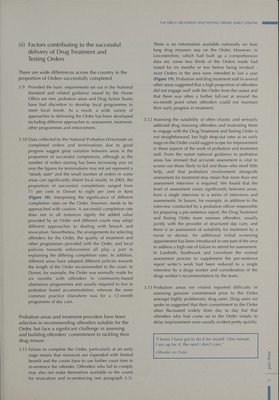
![=e) The fact that some offenders continue to misuse drugs, or relapse during or subsequent to treatment, mirrors experience of treating drug misusers more generally. The National Treatment Outcome Research study, which was commissioned by the Department of Health to study the outcome for drug misusers entering treatment in residential or community methadone programmes in 1995 and was followed up subsequently, found for example that about 40 per cent of people treated in the initial study were still using heroin at least once a week four to five years later. 2.0 oy It is still early to assess the impact of the Order on re-offending rates - a large enough number of completions is required and sufficient time beyond the end of the Order to enable reliable conclusions to be drawn. Most of the probation areas we visited did not collect data on the seriousness of any offences committed whilst on the Order nor assess the offending status of offenders at termination of the Order, as measures of their success. The study of reconviction of offenders in the three pilots of the Drug Treatment and Testing Order - in Croydon, Liverpool and Gloucestershire - is the only evidence collected to date on the impact the Order is having on re-offending rates. The South Bank University team found that overall 80 per cent of the 174 offenders, Drug Treatment and Testing Order! for drug-misusing offenders. Schedule 1A6! community sentence. The RAPt programme? SHS) whose cases could be followed from the original sample of 210, had been reconvicted in the two years after commencement of their Order. For those who completed their Order (30 per cent) the two year reconviction rate was significantly lower at 53 per cent, and for this group the average number of convictions each year reduced from a high point of around 6 in the year before the Order to under 2 for the two years after commencement of the Order??. The South Bank University team found that the Drug Treatment and Testing Order in the pilot areas had achieved lower reconviction rates than was achieved on the Schedule 1A6 Probation Order in the other two areas studied, despite being targeted at a group with a history of more serious and persistent offending behaviour. The RAPt treatment programme, which has been delivered to male prisoners in the UK, has achieved a lower reconviction rate amongst those completing the programme. This may be attributable to working with offenders with different histories of offending behaviour and drug misuse and differences in the nature of the interventions, including the fact that the RAPt treatment model seeks to arrange for offenders to receive on-going support upon leaving custody. The National Treatment Outcome Research Study, which assessed residential and community programmes, found that clients reported significantly reduced levels of acquisitive crime after treatment: two years after entering treatment criminal involvement was reduced by half, though between 20 and 30 per cent reported continued involvement in crime (Figure 17). achieve total abstinence woe drugs and alcohol. Reviewed 54 residential rehabilitation and _ community treatment programmes representing me main range of approaches in place. National Treatment Outcome Research study3 Sources: 1 The impact of Drug Treatment and Testing Orders on offending: two year reconviction results. Home Office Findings 184. Offenders in the pilot y group on the Drug Treatment and Testing Order had an average of 42 previous convictions Ss 2 Prisoners' drug use and treatment: seven studies. Home Office Research Study 267. Offenders completing the RAPt programme who were followed v up had an average of 22 previous convictions © = 3. National Treatment Outcome Research after five years, M Gossop, ] Marsden and D Stewart, 2001 26](https://iiif.wellcomecollection.org/image/b32221733_0032.jp2/full/800%2C/0/default.jpg)
 No text description is available for this image
 No text description is available for this image
 No text description is available for this image