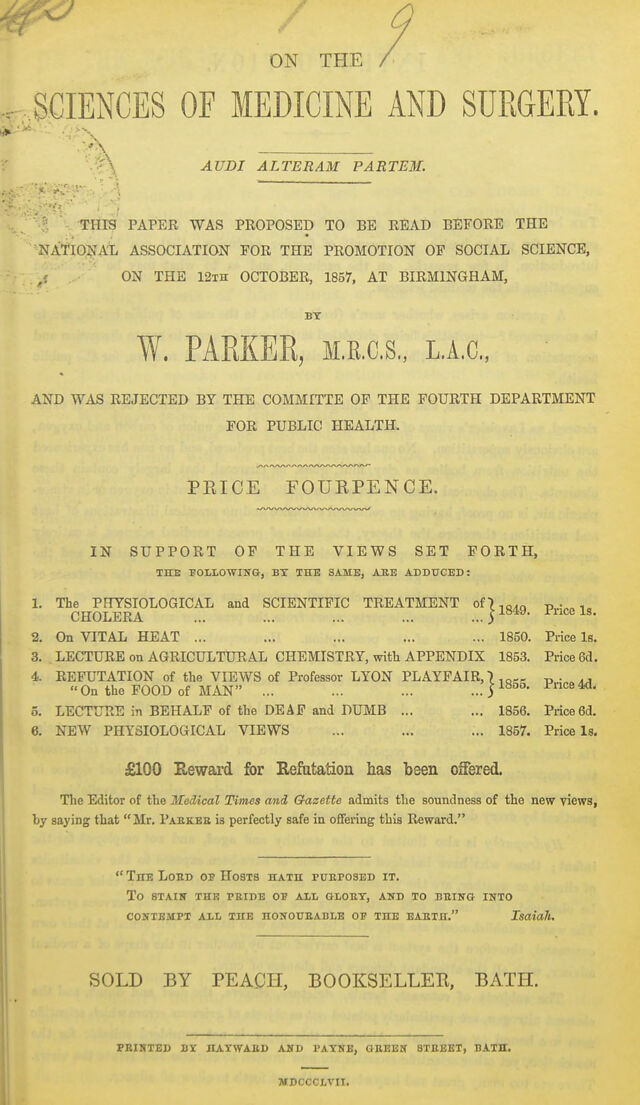
Licence: Public Domain Mark
Credit: On the sciences of medicine and surgery. Source: Wellcome Collection.
Provider: This material has been provided by The Royal College of Surgeons of England. The original may be consulted at The Royal College of Surgeons of England.
6/12 page 4
![The discovery, in 1772, of the element nitrogen in our atmos- phere, and its uses not heing yet appropriated, will appear a great blot on medical science. The misapplication of the uses of the elements carbon and oxygen, in producing heat and nutrition, are also great blots on medical science. Because such a man as Lavoisier, about 70 years ago, is supposed to have given such adaptations, are v.-e bound by respect to antiquity to perpetuate such great blunders ? ■ Certainly not. Galen's teaching that the arterial system was part of the respiratory system—consequently air must be in the arteries—was dogmatical, bigotry, and false. He always found blood in the arteries ; and no one has found heat or nutrition to be effected by the union of carbon or oxygen. These theories, or traditions, were, and are, dogmatical, bigoted, and false. The facts of carbonic acid gas causing the fall of quicksilver in the thermometer, and causing the heated body in fever and in warm weather to be cooled, are too palpable to be lost sight of, or to be highly esteemed for contrary or imaginary effects. The facts of nitrogenous vegetables and medicines being employed to renovate the fatigued body and mind, and to restore health, are too palpable to be cast aside and to be thought nothing of. Our daily foods being found analogous to the human blood, are too palpable to be cast aside. The blood is the life. The blood is the means of healing and curing all diseases and injuries; the blood must, therefore, be preserved in a iiormal state. We are in the age of thinking and acting without being bound down by a state, colleges, or bigotry, or superstition, or traditions, in matters of facts and of science. We adduce examples in physi- ology, in analogy, in chemistry, and in anatomy. laPb-iolo physiology of tea, cofFee, blood, brain, and bile; ^°°^^'that tea and coffee are foods of ordinary use, with much importance being attached to them, because they supply the blood ■with ingredients that are allied to the blood, brain, and bile. In analogy, that similitude exists between food. In Analogy. ^Qg^Ugine^ and blood ; that the aqueous humour dissolves t'le lens in the adult as well as in the infant; and that the cure of cholera is effected by the uses of nitrogenous food and medicine. (See hereafter.) In chemistry, the discovery of alkaloids in tea, coffee. In Chemistry, ^^^.j^^ opium, &c.. and of similar ingredients in the brain, bile, and blood, and also of ammonia escaping largely from cholera patients. (See Liebig's Afiimal Chemistry.J In anatomy, that the transparent cornea, aqueous In Anatomy. ]^„j^our^ capsule of the lens, and the lens, can be perfo- rated frequently with a needle, without pain and without Cataract. . ^^^g ^^^^^.^g ^^^^^ iggg yascular than other ex- ternal parts of the body. That hernia consists of soft parts of different degrees Hernia. organization. The external parts are the skin, cellular tissue, and fat, and are little organized. The internal parts are the](https://iiif.wellcomecollection.org/image/b2228073x_0006.jp2/full/800%2C/0/default.jpg)