History, theory, and practice of the electric telegraph / By George B. Prescott.
- George Bartlett Prescott
- Date:
- 1866
Licence: Public Domain Mark
Credit: History, theory, and practice of the electric telegraph / By George B. Prescott. Source: Wellcome Collection.
Provider: This material has been provided by the Harvey Cushing/John Hay Whitney Medical Library at Yale University, through the Medical Heritage Library. The original may be consulted at the Harvey Cushing/John Hay Whitney Medical Library at Yale University.
125/532
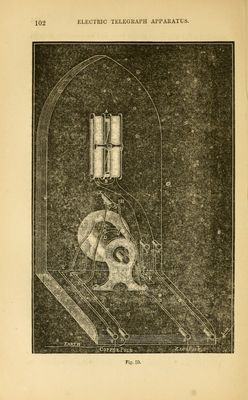
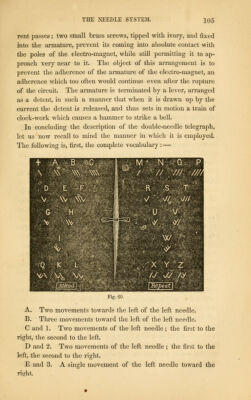
![rent passes; two small brass screws, tipped with ivory, and fixed into the armature, prevent its coming into absolute contact with the poles of the electro-magnet, while still permitting it to ap- proach very near to it. The object of this arrangement is to prevent the adherence of the armature of the electro-magnet, an adherence which too often would continue even after the rupture of the circuit. The armature is terminated by a lever, arranged as a detent, in such a manner that when it is drawn up by the current the detent is released, and thus sets in motion a train of clock-work which causes a hammer to strike a bell. In concluding the description of the double-needle telegraph, let us now recall to mind the manner in which it is employed. The following is, first, the complete vocabulary: — \ >\5^\Vim- / ///////// V - \V \\V Q K L Fig. 60. V V/ \J/J <5 u V <// J- w ^ yx Y Z /J yj '/</■'■ Repeat] A. Two movements towards the left of the left needle. B. Three movements toward the left of the left needle. C and 1. Two movements of the left needle; the first to the right, the second to the left. D and 2. Two movements of the left needle ; the first to the left, the second to the right. E and 3. A single movement of the left needle toward the rigrht.](https://iiif.wellcomecollection.org/image/b21007652_0125.jp2/full/800%2C/0/default.jpg)
 No text description is available for this image
 No text description is available for this image
 No text description is available for this image