Siluria : a history of the oldest rocks in the British Isles and other countries with sketches of the origin and distribution of native gold, the general succession of geological formations, and changes of the earth's surface / by Sir Roderick Impey Murchison.
- Roderick Murchison, 1st Baronet
- Date:
- 1867
Licence: Public Domain Mark
Credit: Siluria : a history of the oldest rocks in the British Isles and other countries with sketches of the origin and distribution of native gold, the general succession of geological formations, and changes of the earth's surface / by Sir Roderick Impey Murchison. Source: Wellcome Collection.
93/774 page 63
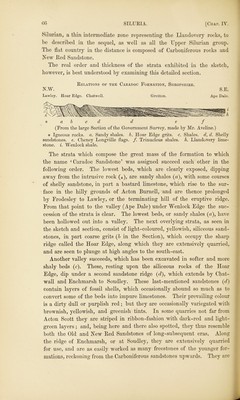
![CIIAPTEE IV. LOWER SILURIAN ROCKS {continncd). THE CARADOC FORMATION.—SHELLY SANDSTONES OP CAER CARADOC.—GENERAL CHARACTER AND ORDER IN THE TYPICAL SILURIAN TRACT OF SHROPSHIRE.—CHIEF ORGANIC REMAINS AS DISTINGUISHED FROM THOSE OF THE LLANDEILO FORMATION. GREAT MASSES OP THE • SLATY ROCKS OF WALES, INCLUDING THE BALA LIMESTONE, SHOWN TO BE THE EQUIVA- LENTS OP THE CARADOC OP SHROPSHIRE.—IGNEOUS ROCKS, COTEMPORANEOUS AND ERUP- TIVE, OF LOWER SILURIAN AGE. i >1 That certain sandstones and shales with occasional calcareous or shelly I courses overlie the schistose rocks of the Llandeilo formation in Wales, has ! already been indicated *. But before we pursue their clear and consecutive ! relations, let us view those masses of the same age in Shropshire, which, with j their fossils, were originally described as a formation younger than the j Llandeilo flags, and as underljnng all the Upper Silurian rocks. For, this Caradoc formation and its characteristic fossils having been described and named many years before its equivalents in Wales were brought into k' comparison or their fossils examined, the account of the original type [ naturally precedes any description of strata subsequently ascertained to be j of the same age. j In Shropshire, the Caradoc Sandstone, so named from the ridge on the ( flanks of which it is weU exposed, is cut off, as formerly shown, from the \ next deposits below it, namely the Llandeilo flags, by the intervention of li the Cambrian rocks of the Longmynd(see Map). Whilst a perfectly sym- c metrical ascending order occurs, as already stated, on the west flank of the ] Longmynd, from the Cambrian into the lowest of the Silurian rocks, and 1 from them into the Llandeilo formation, in vain do we look on the eastern ■ side of that mountain for any representative of the Stiper Stones and the great Llandeilo formation of the Shelve and Corndon tract (p. 38). I The steep slopes of the Longmynd which overhang the valley of Church : Stretton exhibit, as already shown (p. 20), the escarpment of the lowest beds of that enormous mass of ancient sedimentary rocks. (See Map.) Immediately to the east of that valley is seen the line of a jiowerful fault, the vertical dimensions of which have been estimated (by Professor Eamsay) at not less than 2000 feet, the place of tlie intervening strata being taken by igneous rocks. The latter having been erupted at a period ■ long after the formation of the original sediments, have altered the schists into hard clay-slates, and the sandstones into quartz-rock. Those igneous * Sep also general section beneath Map, and local sections (pp. 65 Sc dO).](https://iiif.wellcomecollection.org/image/b28094360_0093.jp2/full/800%2C/0/default.jpg)


 No text description is available for this image
 No text description is available for this image
 No text description is available for this image