The book of nature; or, the history of insects: reduced to distinct classes, confirmed by particular instances, displayed in the anatomical analysis of many species, and illustrated with copper-plates ... / by John Swammerdam, M.D. With the life of the author, by Herman Boerhaave, M.D. Translated from the Dutch and Latin original edition by Thomas Flloyd.
- Jan Swammerdam
- Date:
- 1758
Licence: Public Domain Mark
Credit: The book of nature; or, the history of insects: reduced to distinct classes, confirmed by particular instances, displayed in the anatomical analysis of many species, and illustrated with copper-plates ... / by John Swammerdam, M.D. With the life of the author, by Herman Boerhaave, M.D. Translated from the Dutch and Latin original edition by Thomas Flloyd. Source: Wellcome Collection.
610/614 (page 336)
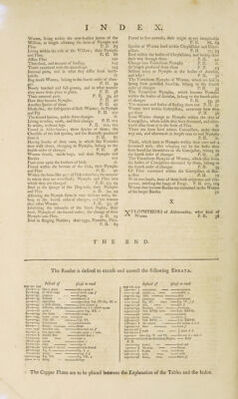
![Worms, living within the new-budded leaves of the Willow, at length affuming the form of Nymphs and Flies. P.n. ,85 Living within the rofe of the Willow s their Nymphs and Flies. R H* 86 Affine Flies l42 Their food, and manner of feeding. 143 Tooth examined with the microfcope . 143 Internal parts, and in what they differ from earth- infedfs. ib. Bog-houfe Worms, belong to the fourth order of chan¬ ges P. II. 34 Newly hatched and full-grown, and in what manner they move from place to place. P. II. 38 Their external parts P. II. 39, 40 How they become Nymphs. P. II. 4° Another fpecies of them. P. II. 41 Moth-like, the firft fpecies of thefe Worms; its Nymph and Fly P. II. 100 The fecond fpecies, and its three changes. ib. Living in tubes, earth, and their change. P. II. 101 In water, without legs. P. II. 101, 102 Found in Alder-leaves; three fpecies of them; the Chryfalis of the firit fpecies, and the Butterfly produced from it P.II. 87 Having houfes of their own, in which like Tortoifes they walk about, changing to Nymphs, belong to the fourth order of changes P. II. 3^ Worms found, musk-bags, and their Nymphs and Beetles 101 Feed even upon the feathers of birds ib. Found within the bottom of the Oak, their Nymphs and Flies P. II. 9° Within the bean-like part of Oak tubercles ; the manner in which they are nourifhed ; Nymphs and Flies into which they are changed P. II. 93’ 94 Bred in the fponge of the Dog-rofe, their Nymphs and Flies p. II. 94’ 94 Affuming the Nymph form in very delicate webs, be¬ long to the fourth order of changes, and lefs known than other Worms. .P.II. 37, 38 Inhabiting the tubercles of the black Poplar, their food, Nymphs of the fecond order•, the change of their Nymphs into Flies. p. II. 95 Bred in Hinging Nettles; their eggs, Nymphs, Flies. P. II. 89 Found in live animals, their origin as yet inexplicable P. II. 68, 69 Species of Worms bred within Chryfallides and Cater¬ pillars. P. II. 70, 99 Bred within the bodies of Chryfallides, and boring their their way through them • P. II. 42 Change into Vermiform Nymphs P. II. ib. At length produced from them P. II. 43 Seldom turns to Nymphs in the bodies of Aurelias, and why ? P. II. 36 The Vermiform Nymphs of Worms, which are faid to fpring from putrified Aureliae, belong to the fourth order of changes P. II. 35 The Vermiform Nymphs, which become Nymphs within the bodies of Aurelise, belong to the fourth order of changes P. II. 35, 36 The manner and feafon of finding them out P. II. 37 Worms bred within Caterpillars, uncertain how they get there P. II 36 Some Worms change to Nymphs within the skin of Caterpillars, whofe infide they have devoured, and after¬ wards iffue from it in the form of Flies ib. There are fome bred within Caterpillars, make their way out, and afterwards at length turn to real Nymphs P. II. ib. Thofe, which turn to Nymphs Within their own and a borrowed web, after creeping out by the holes they have bored for themfelves in the Caterpillar, belong to the fourth order of changes P. II. 38 The Vermiform Nymphs of Worms, which iffue from the bodies of Caterpillars devoured by them, belong to the fourth order of.changes P. II. 35 Of Flies contained within the Caterpillars of But¬ terflies P. II. 71 With two heads, fome of them both oviparous and vivi¬ parous, infefting the lungs of Frogs. P.II. 101,109 Worms that become Beetles are contained in the Worms of the larger Beetles X VYLOPHTHORI of Aldrovandus, Worms 71 what kind of P. II. 38 THE END. The Reader is defired to excufe and corred the following Errata. i Page Col. Line 31— a— 3 32— 1—44 39—2—47 46—2—34 52— 2—37 53— 2—45 56— 2—33 57— I—iS 60—1—54 61-.44 63—1—45 65—2—29 67—i— i -56 69—1— 4 73—1— 8 —- '2-10 76— 1 — 36 77— 2—3, 90-2-40 98-1—50 ■-2-II 100-2—54 IQ!- — 2 pleafe to read In/ïead of like a point of thofe rings pidgeons ftomach operculum - - a little dilated, differens, whichiopens-defferens b h which openn penis e --penis Fig. XX, e the brain ---the brain c Tab. IV. -Tab. VI, halictations --habitations Stenon • --Steno ——like a point b —■ of thofe rings f ■ - Pigeons. —ftomach h —operculum Tab. IV. Fig. III. m a little dilated g ftretched out, - two upper ones divided Ikin tube — . uterus ridge —-— obferved b feveral Fig. I-- - wings Fig. VII. belong -Stretched out f -two upper c c ones -divided Ikin e -tube z .uterus e -ridge b -obferved feveral -Fig. I. a -wings d d -Fig. VII. a -ibelongs Injiead of pleafe to read Page Col. Line 102-1- I entraneous — —extraneous *— 2—48 middle e, --■ -middle c. IO4-1—29 1661 -- -1671 108—i— e exuberant — -extu berant -— 2--21 Fig. IV. -- -Fig. IV. ƒ ƒ 109—2—58 this, -- -'this ƒ, 122-1-44 Panopes, - — -Panorpes, 132—1—51 Tab. XVII. - -Tab. XXVII. --40 *35 1 29 136—i—37 Tab!’xVII. — Tab. XXVII. 138— 2— 8 the nerves -- --the nerves d d d 139— I—21 knot - ■ --knot f 140— I Lift ? teet]j . - £ teeth d d line but one 5 ( 152—I— after Fig. V. and VI. -blot out b c and d 163—i—7thlinefromthebottom Delphos — Delfc P. II. XI—I—33 head a — ———head and 53—1— 8 Hornius - -Horne 141—i— 8 Stento - -Steno 146—i—13 with .-- -1 with 149—2—26 fibres, — --fibres ƒ, c The Copper Plates are to be placed between the Explanation of the Tables and the Index.](https://iiif.wellcomecollection.org/image/b30448542_0610.jp2/full/800%2C/0/default.jpg)