Annual medical and sanitary report of the Director of Medical Services / Trinidad and Tobago.
- Trinidad and Tobago. Department of Medical Services.
- Date:
- [1945]
Licence: Attribution 4.0 International (CC BY 4.0)
Credit: Annual medical and sanitary report of the Director of Medical Services / Trinidad and Tobago. Source: Wellcome Collection.
13/28 page 11
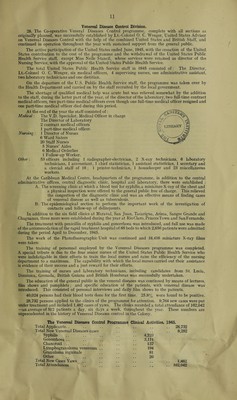
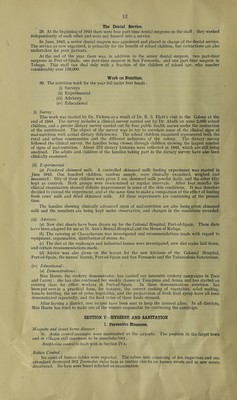
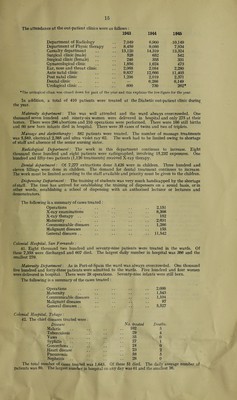
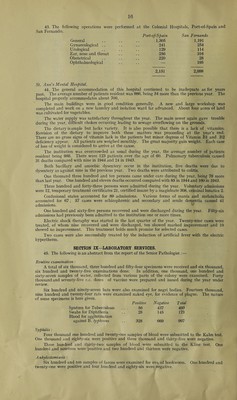
![Venereal Disease Control Division. 28. The Co-operative Veneral Diseases Control programme, complete with all sections as originally planned, was successfully established by Lt.-Colonel O. C. Wenger, United States Adviser on Venereal Diseases Control with the help of the combined United States and British Staff, and continued in operation throughout the year with susta ined support from the general public. The active participation of the United States ended June, 1945, with the cessation of the United States contribution to the cost of the programme and the withdrawal of the United States Public Health Service staff, except Miss Nelle Stancil, whose services were retained as director of the Nursing Service, with the approval of the United States Public Health Service. The total United States Public Health Service staff in 1945 consisted of: The Director, Lt.-Colonel O. C. Wenger, six medical officers, 4 supervising nurses, one administrative assistant, two laboratory technicians and one dietitian. On the departure of the U.S. Public Health Service staff, the programme was taken over by the Health Department and carried on by the staff recruited by the local government. The shortage of qualified medical help was acute but was relieved somewhat by the addition to the staff, during the latter part of the year, of the director of the laboratory, two full-time contract medical officers, two part-time medical officers even though one full-time medical officer resigned and ne medical officer died during this period. end of the year the staff consisted of : The V.D. Specialist, Medical Officer in charge The Director of Laboratory 2 contract medical officers 1 part-time medical officer. 1 Director of Nurses 6 Ward Sisters 20 Staff Nurses 5 Nurses’ Aides 6 Medical Orderlies 1 Follow-up Worker. 53 officers including 1 radiographer-electrician, 2 X-ray technicians, 6 laboratory technicians, 1 accountant, 1 chief statistician, 1 assistant statistician, 1 secretary and a clercial staff of 16; 1 printer-technician, 1 housekeeper and 23 miscellaneous workers. At the Caribbean Medical Centre, headquarters of the programme, in addition to the central administrative offices, central diagnostic clinic, hospital and laboratory, there were established : A. The screening clinic at which a blood test for syphilis, a miniature X-ray of the chest and a physical inspection were offered to the general public free of charge. This relieved the congestion of the diagnostic clinic and was an effective means of finding cases of venereal disease as well as tuberculosis. B. The epidemiological section to perform the important work of the investigation of contacts and follow-up of delinquents. In addition to the six field clinics at Maraval, San Juan, Tacarigua, Arima, Sangre Grande and Chaguanas, three more were established during the year at RioClaro, Princes Town and San Fernando. The treatment with penicillin of syphilis and gonorrhoea was introduced, and full use was made of the accommodation of the rapid treatment hospital of 88 beds to which 2,656 patients were admitted during the period April to December, 1945. The work of the Photofluorographic Unit was continued and 18,416 miniature X-ray films were taken: The training of personnel employed by the Venereal Diseases programme was completed. A special tribute is due to the four senior nurses of the United States Public Health Service who were indefatigable in their efforts to train the local nurses and raise the efficiency of the nursing department to a maximum. The capability with which the local nurses carried out their assistance is evidence of their success and a just reward for their efforts. The training of nurses and laboratory technicians, including candidates from St. Lucia, Dominica, Grenada, British Guiana and British Honduras was successfully undertaken. The education of the general public in the veneral diseases was continued by means of lectures, film shows and pamphlets; and specific education of the patients, with venereal disease was introduced. This consisted of personal interviews and daily film shows to the patients. 40,024 persons had their blood tests done for the first time. 25.8% were found to be positive. 28,732 persons applied to the clinics of the programme for attention. 9,764 new cases were put under treatment and included 1,482 cases of yaws. The clinics recorded a total attendance of 162,042 —an average of 512 patients a day, six days a week, throughout the year. These numbers are unprecedented in the history of Venereal Diseases control in the Colony. The Venereal Diseases Control Programme Clinical Activities, 1945. 28,732 8,282 1,482 .. 162,042 Total Applicants Total New Venereal Diseases cases Syphilis .. .. .. .. .. 4,733 Gonorrhoea.. .. .. .. .. 3,111 Chancroid .. .. .. .. .. 137 Lymphogranuloma venereum .. .. .. 194 Granuloma inguinale .. .. .. 81 Other .. .. .. .. .. 26 Total New Cases Yaws Total Attendances one part-ti] At the Medical: Nursing: Other :](https://iiif.wellcomecollection.org/image/b31483343_0013.jp2/full/800%2C/0/default.jpg)