On the detection of aconite by its physiological action : being notes of experiments made in connection with the trial of Dr. E.W. Pritchard / by Frederick Penny and James Adams.
- Date:
- 1865
Licence: Public Domain Mark
Credit: On the detection of aconite by its physiological action : being notes of experiments made in connection with the trial of Dr. E.W. Pritchard / by Frederick Penny and James Adams. Source: Wellcome Collection.
Provider: This material has been provided by the Royal College of Physicians of Edinburgh. The original may be consulted at the Royal College of Physicians of Edinburgh.
29/32 page 25
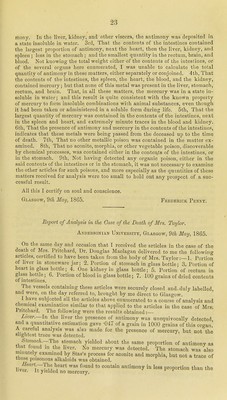
![daotion were marked No. 1 to No. 7 inclusive. No. 1 contained a small lump of crystallized nitrate of silver, weighing 16-5 grains. It contained no antimony. No. 2 contained 132 grains of cummin seed in powder. Neither antimony nor mercury was found in it. No. 3 contained 143 grains of sugar of lead. Nothing extraneous was detected. No. 4. The contents of this package consisted of a mix- ture of mercury and chalk, weighing together 65 giains, and it was evidently the medical preparation called Hydrargyrum c. Creta.'' No antimony was found in it. No. 5 contained a lump of opium, weighing 110 grains. No. 6 contained 13'5 grains of morphia, contaminated with a small quantity of nitrate of silver, which, from the appearance of the paper package, had manifestly enfiltered accidentally from without. No. 7 contained 1350 grains of a white, gritty, crystalline powder, which was found to have all the physical and chemical properties of sugar of milk. It was carefully tested for mercury, antimony, and other substances, but the results were entirely negative. This bottle [D] contained 18 fluid ounces of ginger wine. No antimony or mercury was detected. This phial [E] contained 3-5 grains of a white powder, which was found by analysis to be tartarized antimony. The three phials [P] included in this production were labelled respectively 1, 2, and 3. No. 1 contained one ounce and three drachms of tincture of conium. No. 2 contained five drops of the same tincture. No. 3 contained two and one half drachms of the same preparation. This phial [G] contained nine drachms and a half of a light yellow-coloured liquid, having the taste and odour of cinnamon, and consisting of a mixture of medicinal substances. It contained no antimony and no mercury. This cheese [H] was tested for anti- mony and mercury, but no evidence of the presence of these metals was obtained. This production [I] included six small phials, which were found to contain as follows :—No. 1. Four drops of tincture of aconite; No. 2. Twelve drops of the same tincture. No. 3. Thirty drops of the tincture of conium. No. 4. Fourteen drops of the tincture of conium. No. 5. Empty. No. 6. Nine drops of the tinc- ture of digitalis. Tliis paper package [K] contained 1695 grains of tapioca. Not the least trace of either antimony or mercury was detected in this tapioca. All this I certify on soul and conscience. 17!!7i ilfa?/, 1865. Fredekick Penny. Hejport of Analysis of certain Articles referring to the Case of Dr. Pritcliard. Andersonian, Glasgow, I9tk May, 1865. This is to certify that I have subjected to careful analysis and chemical ex- amination the following articles, which were delivered to me on the 15th inst by Alexander M'Call:—No. 1. A brownish-coloured and turbid liquid, measur- ing three fluid ounces, contained in a glass bottle, labelled chloroform. It was tested for antimony and mercury, but not a trace of cither metal was detected It contained no aconite. No. 2. A white crystalline powder, contained in a small cylmdncal wooden box, with screw cover. It weighed 15-5 grain.s and was found to consist of a mixture of tartarized antimony and arsenious acid (that 13, the common poison of arsenic) in nearly equal proportions by weiQ;ht No 3 About ten drops of colourless liquid, contained in a quart wine bottle. It was lound to bo an aqueous solution of corrosive sublimate. No. 4 (A ) A white powier, contained in a circular red pasteboard box. It weighed five grains and was fnund to be calomel. No. 4. (B.) A white powder, weighing 35 g^-ains con- ta ned in a green pasteboard box. It was found to be taitfrizcd a, imo.iy All the productions containing the articles subjected to analysis were eecmX closed, and had sealed labels attached. ^ eecuielj Fhederick Penny. d](https://iiif.wellcomecollection.org/image/b2195379x_0031.jp2/full/800%2C/0/default.jpg)




 No text description is available for this image
 No text description is available for this image
 No text description is available for this image