Volume 2
Collected papers of R. A. Fisher / edited by J.H. Bennett.
- Ronald Fisher
- Date:
- 1971-1974
Licence: Attribution-NonCommercial 4.0 International (CC BY-NC 4.0)
Credit: Collected papers of R. A. Fisher / edited by J.H. Bennett. Source: Wellcome Collection.
19/568 (page 15)
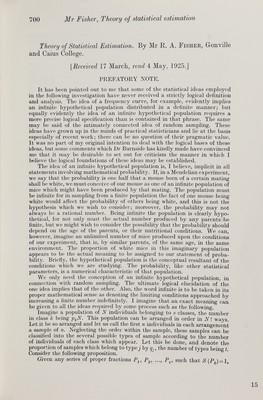
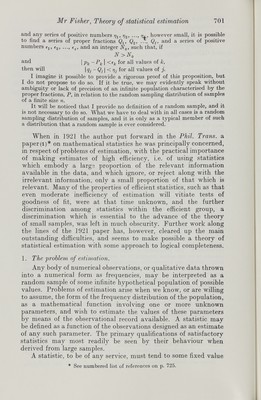
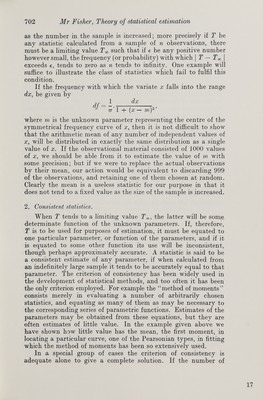
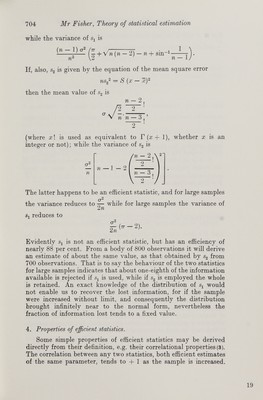
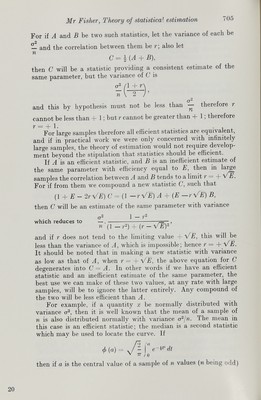
![Theory of Statistical Estimation. By Mr R. A. Fisher, Gonville and Cams College. [Received 17 March, read 4 May, 1925.] PREFATORY NOTE. It has been pointed out to me that some of the statistical ideas employed in the following investigation have never received a strictly logical definition and analysis. The idea of a frequency curve, for example, evidently implies an infinite hypothetical population distributed in a definite manner; but equally evidently the idea of an infinite hypothetical population requires a more precise logical specification than is contained in that phrase. The same may be said of the intimately connected idea of random sampling. These ideas have grown up in the minds of practical statisticians and lie at the basis especially of recent work; there can be no question of their pragmatic value. It was no part of my original intention to deal with the logical bases of these ideas, but some comments which Dr Burnside has kindly made have convinced me that it may be desirable to set out for criticism the manner in which I believe the logical foundations of these ideas may be established. The idea of an infinite hypothetical population is, I believe, implicit in all statements involving mathematical probability. If, in a Mendelian experiment, we say that the probability is one half that a mouse born of a certain mating shall be white, we must conceive of our mouse as one of an infinite population of mice which might have been produced by that mating. The population must be infinite for in sampling from a finite population the fact of one mouse being white would affect the probability of others being white, and this is not the hypothesis which we wish to consider; moreover, the probability may not always be a rational number. Being infinite the population is clearly hypo thetical, for not only must the actual number produced by any parents be finite, but we might wish to consider the possibility that the probability should depend on the age of the parents, or their nutritional conditions. We can, however, imagine an unlimited number of mice produced upon the conditions of our experiment, that is, by similar parents, of the same age, in the same environment. The proportion of white mice in this imaginary population appears to be the actual meaning to be assigned to our statement of proba bility. Briefly, the hypothetical population is the conceptual resultant of the conditions which we are studying. The probability, like other statistical parameters, is a numerical characteristic of that population. We only need the conception of an infinite hypothetical population, in connection with random sampling. The ultimate logical elucidation of the one idea implies that of the other. Also, the word infinite is to be taken in its proper mathematical sense as denoting the limiting conditions approached by increasing a finite number indefinitely. I imagine that an exact meaning can be given to all the ideas required by some process such as the following. Imagine a population of N individuals belonging to s classes, the number in class k being p k N. This population can be arranged in order in N ! ways. Let it be so arranged and let us call the first n individuals in each arrangement a sample of n. Neglecting the order within the sample, these samples can be classified into the several possible types of sample according to the number of individuals of each class which appear. Let this be done, and denote the proportion of samples which belong to type j by q j , the number of types being t. Consider the following proposition. Given any series of proper fractions P 1 , P 2 , ..., P s , such that S (P k ) = 1,](https://iiif.wellcomecollection.org/image/b18032357_vol_2_0020.JP2/full/800%2C/0/default.jpg)