Licence: Public Domain Mark
Credit: Annual report. List of members. Source: Wellcome Collection.
14/44 page 12
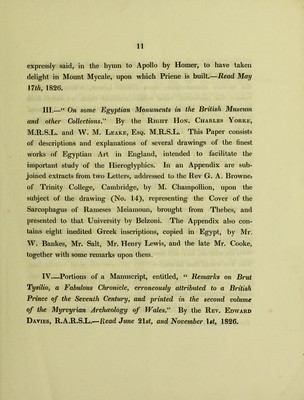
![V.—“ Observations on the First Line of the Iliad.' By Granville Penn, Esq. M.R.S.L. The writer remarks, that while the modern commentators upon Homer labour, without effect, to reduce this celebrated verse within metrical rules, we know from the authority of Plutarch, that it was anciently held to be pecu liar as aper^og, or ‘ excedens mensuram,'> as Henry Stephens renders the word. The object of this Paper is, to inquire how the Greeks, or rather the Poet himself, enunciated the line; in which inquiry Mr. Penn takes for his guide an observation of Plutarch, in the Ninth Book of the “ Symposiacs,” that the first line of the Iliad is equisyllabic with the first line of the Odyssey, as the last line of the Iliad is with the last line of the Odyssey. Accordingly, the last line of each Poem is found to consist of exactly sixteen syllables; but while the number expressed, by the ordinary enunciation, in the first line of the Iliad, gives sixteen syllables, the first line of the Odyssey contains seventeen syllables. Mr. Penn suggests that the Poet, in the first line of the Iliad, paused at the penthemimer, closing with the address, Qsc*; and renewed the arsis on the following syllable. The line would then be read— pviw a. | 0£ ] a—HrjXyi j ia^s | cu A%7 | Xriog. instead of the usual form— p-/]viv ctci^s Qtoc Uyi — AvitaSu A'/jK^og. Read November lsJ, 1826.](https://iiif.wellcomecollection.org/image/b22006023_0016.jp2/full/800%2C/0/default.jpg)


 No text description is available for this image
 No text description is available for this image
 No text description is available for this image