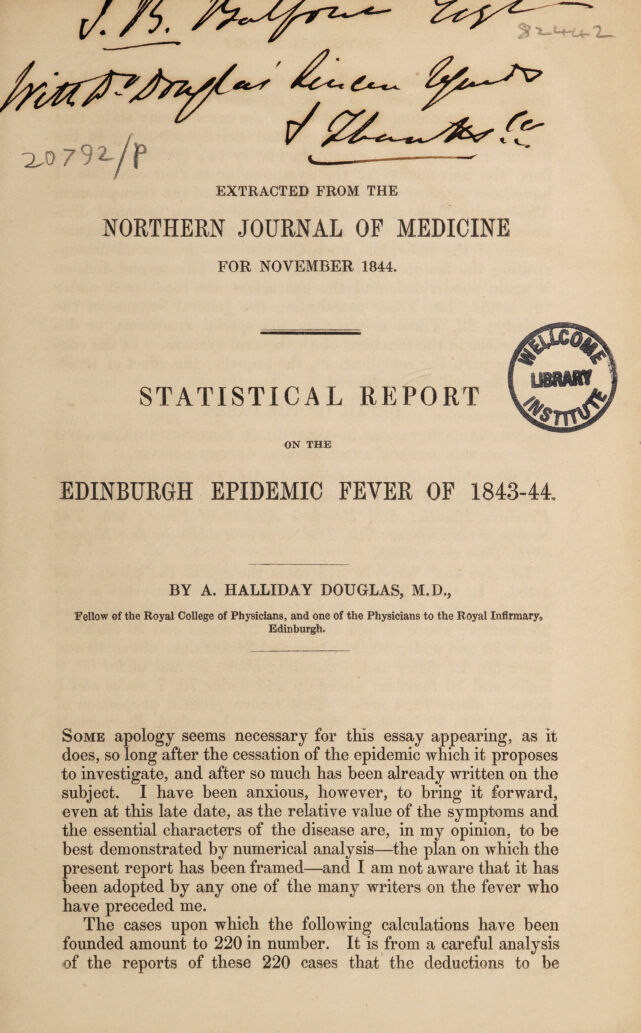
[First] Statistical report on the Edinburgh epidemic fever of 1843-44 / [Andrew Halliday Douglas].
- Douglas, A. Halliday (Andrew Halliday), 1819-1908.
- Date:
- [1844]
Licence: Public Domain Mark
Credit: [First] Statistical report on the Edinburgh epidemic fever of 1843-44 / [Andrew Halliday Douglas]. Source: Wellcome Collection.
2/16 page 2
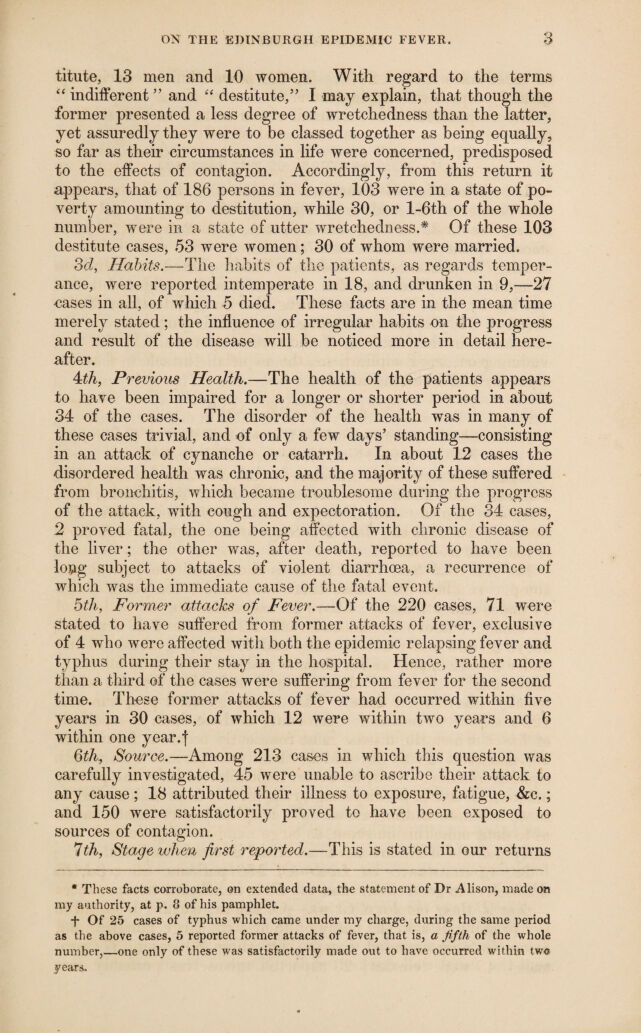
![recorded have been derived. To the phenomena presented by these 1 propose strictly to confine my observations. Before proceeding to the detail of the cases, I may state, that the investigation has been -conducted strictly according to the “ Numerical System,” except in one or two instances, where, from the universality of the symptom or morbid condition, I have been satisfied wdth the mere statement of the circumstance. The results of the analysis are arranged in two principal divi¬ sions ; the first showing the influence of the general circum¬ stances of the individual upon the disease—the second demon- stratino; the features of the disease itself. This second division is ao-ain subdivided, and the characters are considered under two heads : 1st, Those constituting the general features of the malady ; 2d, Those constituting the special symptoms, or de¬ rangement in the functions of the several systems. In the con¬ cluding part, the complications, the sequelae, the effect of treat¬ ment, &c., will be considered. DETAIL OF THE CASES. I.—THE CIRCUMSTANCES OF INDIVIDUAL PATIENTS INFLUENCING THE ATTACK AND PROGRESS OF THE DISEASE. Under this section are considered—Ist, The Sex and Age of the Patients; 2d, Their Circumstances in Life; 3<i, Habits; 4:th, Previous Health; 5th, Previous Attacks of Fever; Qth, The Source of the Disease; Ith, The Stage of it ujhen the first Reports of the Case were taken. 1.9^, Age and Sex.—In 215 cases the age of the patient was noted. In these 215 cases there were under ten years of age 14 males and 4 females; above 10 and under 20, 36 males and 23 females; above 20 and under 30, 32 males and 26 females; above 30 and under 40, 11 males and 21 females; above 40 and under 50, 12 males and 8 females; above 50 and under 60, 9 males and 10 females; above 60 and under 70, 7 males and 1 female; above 70, 1 male. This return gives a proportion of 122 males to 93 females. According to these data, the periods of life at which the disease most frequently occurs is from 10 to 20, and from 20 to 30, and at these two periods with nearly equal frequency. It is, however, impossible to infer the precise influence of age in predisposing to the disease from such materials as we are here making use of. An hospital report cannot enable us to determine this question, as large numbers of patients in the early periods of life arc never admitted into our hospitals. 2d, Circumstances in lAfe.—Of 186 patients, 83 reported themselves in good circumstances ; 80 in indifferent circumstances —that is, their em])loymcnt was precarious, earning from three to five shillings a-week, many of them with large families, and living in over-crowded rooms. Of these 80 cases, 37 were males, 43 were females; 23 repoided themselves ])erfectly des-](https://iiif.wellcomecollection.org/image/b30379313_0002.jp2/full/800%2C/0/default.jpg)