Licence: Public Domain Mark
Credit: The medical student's manual of chemistry. Source: Wellcome Collection.
Provider: This material has been provided by the Gerstein Science Information Centre at the University of Toronto, through the Medical Heritage Library. The original may be consulted at the Gerstein Science Information Centre, University of Toronto.
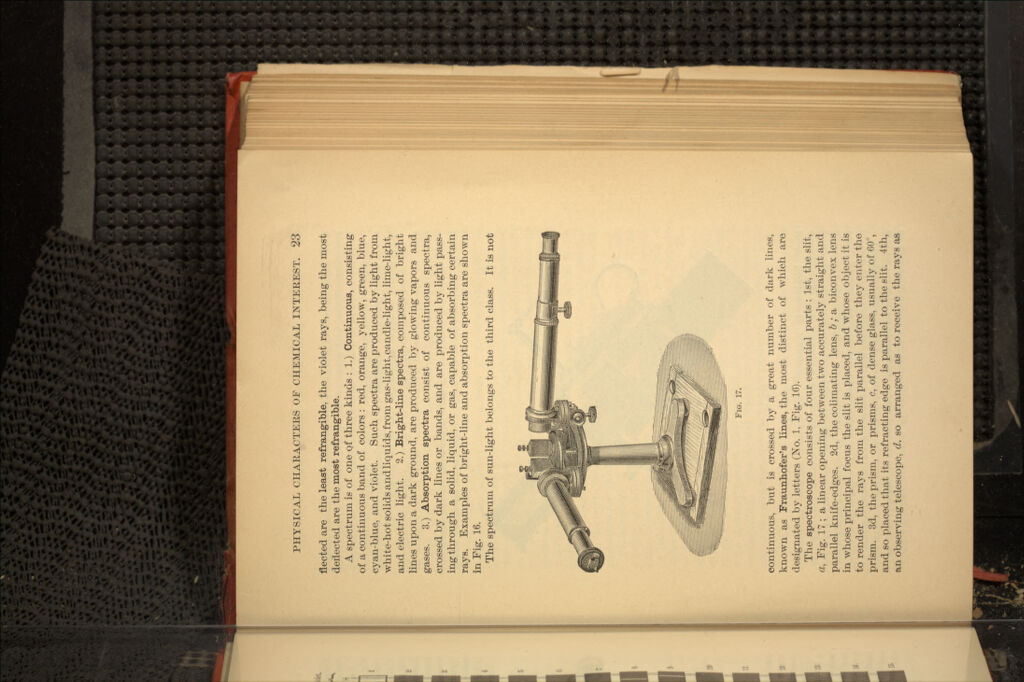
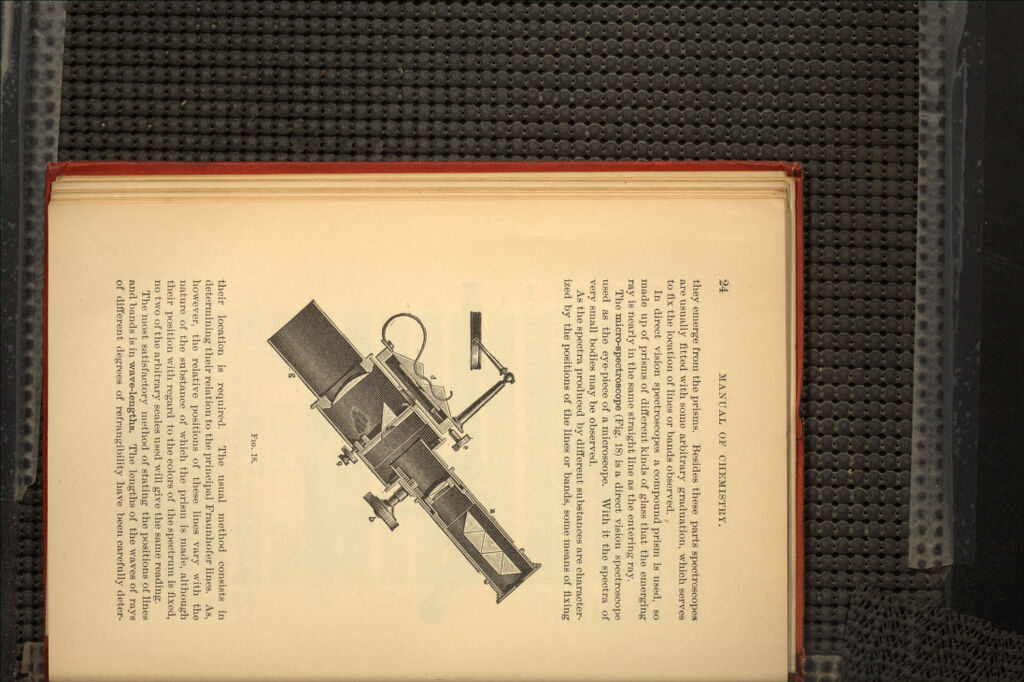
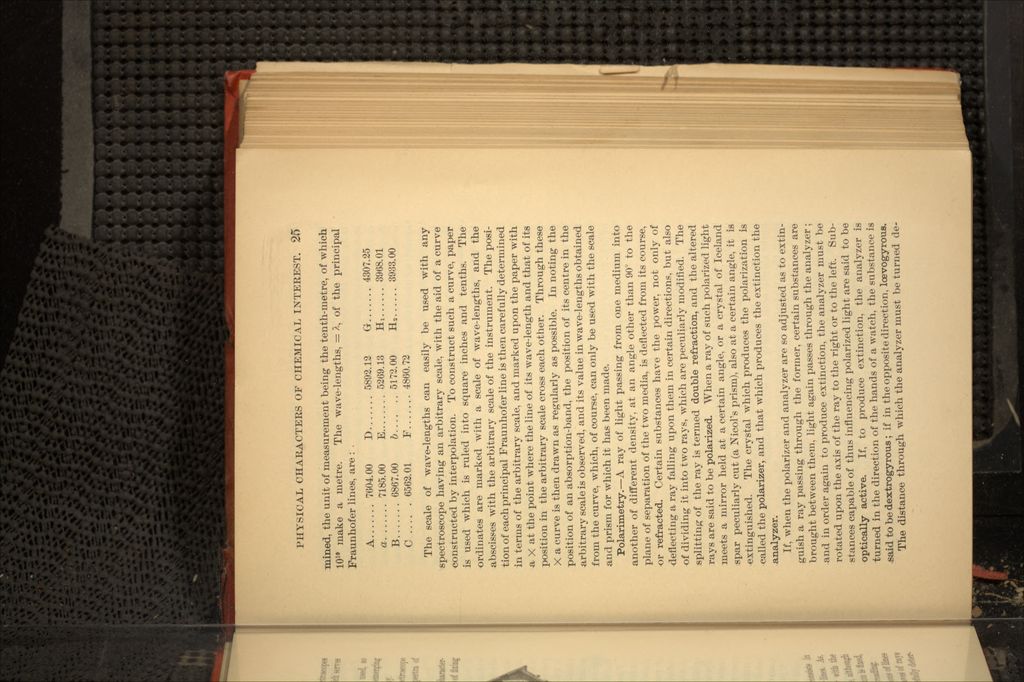
46/586 (page 26)
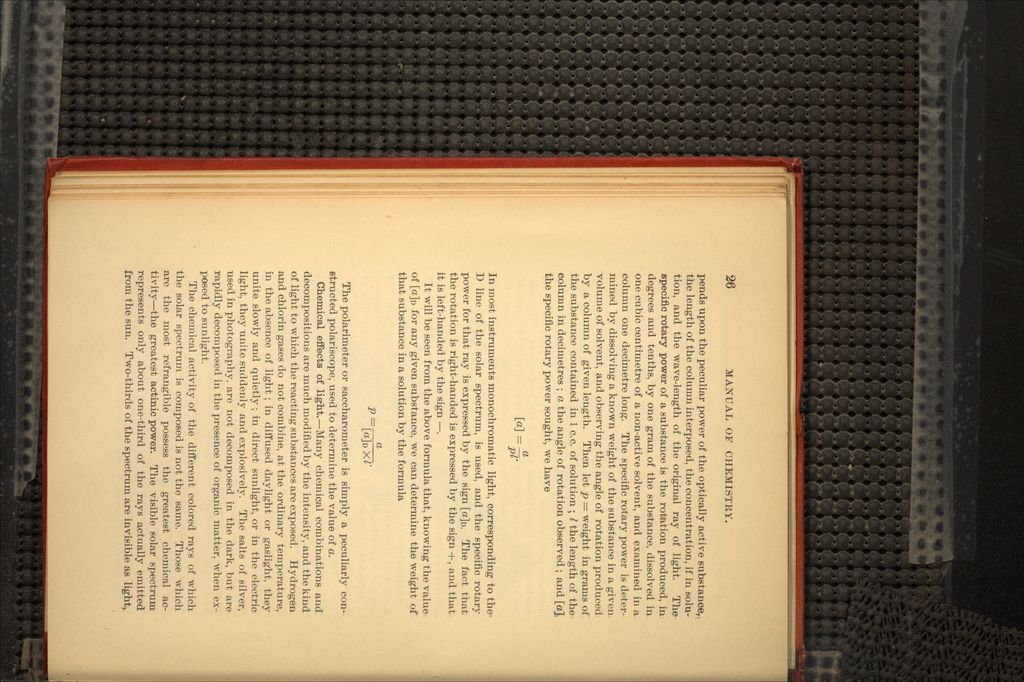
![pends upon the peculiar power of the optically active substance,, the length of the column interposed, the concentration, if in solu- tion, and the wave-length of the original ray of light. The specific rotary power of a substance is the rotation produced, in degrees and tenths, by one gram of the substance, dissolved in one cubic centimetre of a non-active solvent, and examined in a column one decimetre long. The specific rotary power is deter- mined by dissolving a known weight of the substance in a given, volume of solvent, and observing the angle of rotation produced by a column of given length. Then let p = weight in grams of the substance contained in 1 c.c. of solution ; I the length of the column in decimetres ; a the angle of rotation observed ; and [oj the specific rotary power sought, we have r n a [a] = —j. pi In most instruments monochromatic light, corresponding to the- D line of the solar spectrum, is used, and the specific rotary power for that ray is expressed by the sign [a]o. The fact that the rotation is right-handed is expressed by the sign +, and that it is left-handed by the sign —. It will be seen from the above formula that, knowing the value of [«]D for any given substance, we can determine the weight of that substance in a solution by the formula The polarimeter or saccharometer is simply a peculiarly con- structed polariscope, used to determine the value of a. Chemical effects of light.—Many chemical combinations and decompositions are much modified by the intensity, and the kind of light to which the reacting substances are exposed. Hydrogen and chlorin gases do not combine, at the ordinary temperature, in the absence of light; in diffused daylight or gaslight, they unite slowly and quietly; in direct sunlight, or in the electric light, they unite suddenly and explosively. The salts of silver, used in photography, are not decomposed in the dark, but are rapidly decomposed in the presence of organic matter, when ex- posed to sunlight. The chemical activity of the different colored rays of which the solar spectrum is composed is not the same. Those which are the most refrangible possess the greatest chemical ac- tivity—the greatest actinic power. The visible solar spectrum represents only about one-third of the rays actually emitted from the sun. Two-thirds of the spectrum are invisible as light,](https://iiif.wellcomecollection.org/image/b20996901_0046.jp2/full/800%2C/0/default.jpg)