Licence: Public Domain Mark
Credit: The medical student's manual of chemistry. Source: Wellcome Collection.
Provider: This material has been provided by the Gerstein Science Information Centre at the University of Toronto, through the Medical Heritage Library. The original may be consulted at the Gerstein Science Information Centre, University of Toronto.
71/586 (page 51)
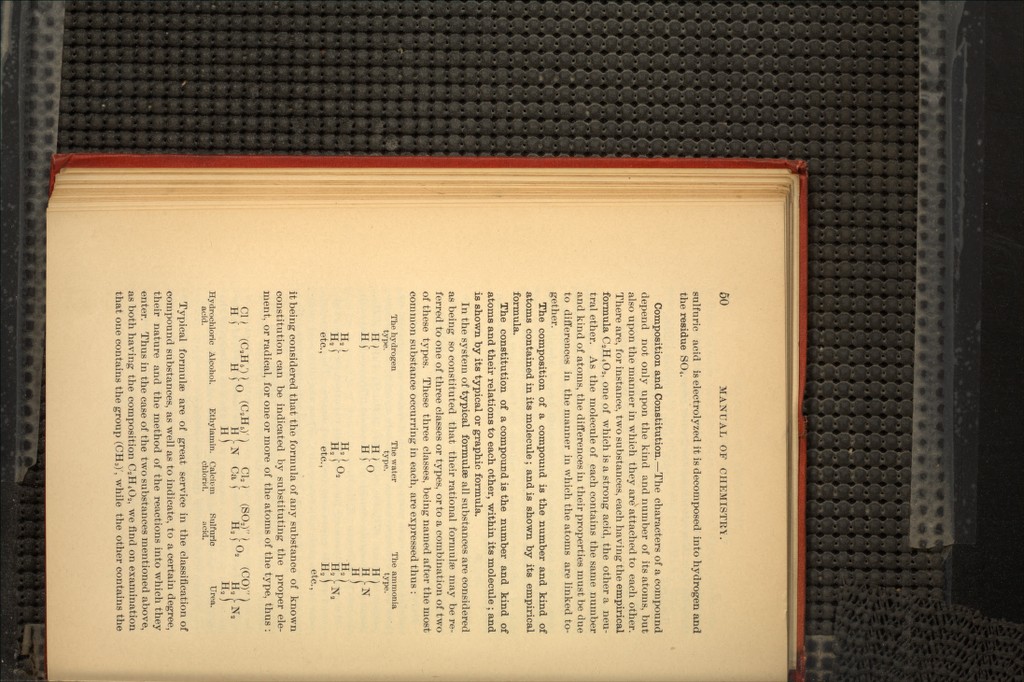
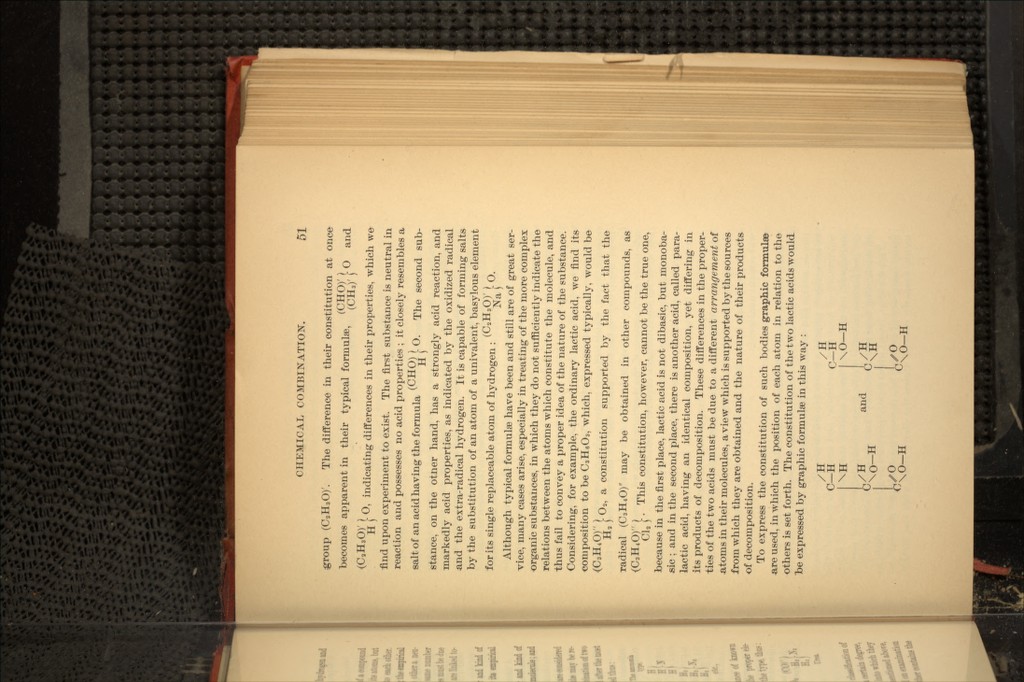
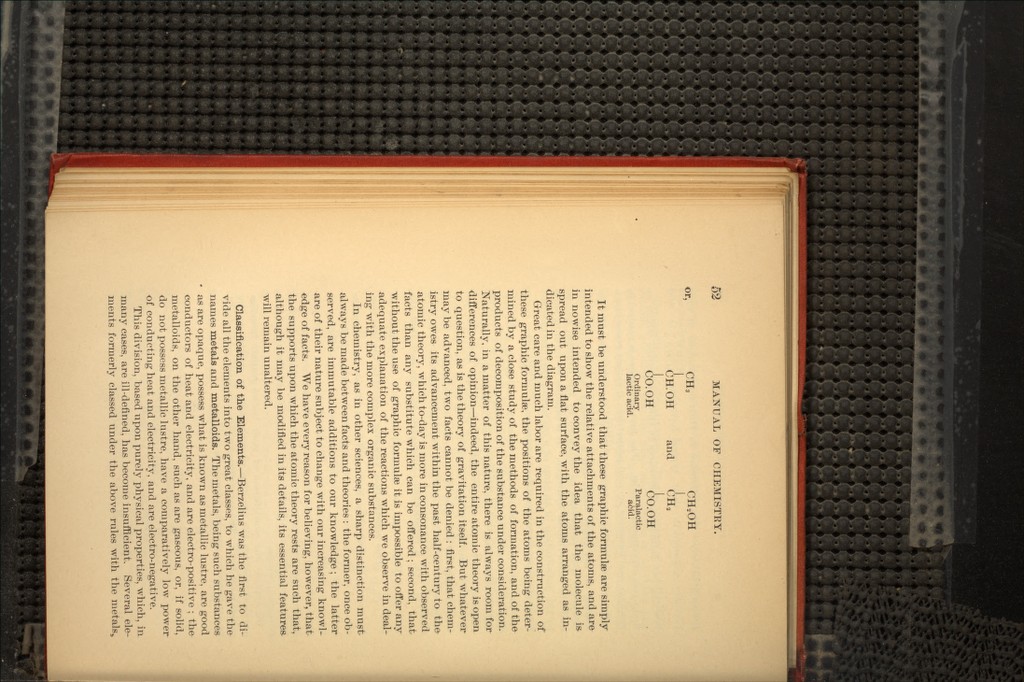
![group (CaHsO)'. The difference in their constitution at once becomes apparent in their typical formulae, /rjjj y r O and //-i TT /-\y j 3 H \ ^' indicating differences in their properties, which we find upon experiment to exist. The first substance is neutral in reaction and possesses no acid properties ; it closely resembles a salt of an acid having the formula ^ Vr [ O. The second sub- stance, on the otner hand, has a strongly acid reaction, and markedly acid properties, as indicated by the oxidized radical and the extra-radical hydrogen. It is capable of forming salts by the substitution of an atom of a univalent, basylous element //~1 TT pvy J for its single replaceable atom of hydrogen : v *-*r' 5- O. Although typical formulae have been and still are of great ser- vice, many cases arise, especially in treating of the more complex organic substances, in which they do not sufficiently indicate the relations between the atoms which constitute the molecule, and thus fail to convey a proper idea of the nature of the substance. Considering, for example, the ordinary lactic acid, we find its composition to be CsHeOa, which, expressed typically, would be (C3 O) [ O2, a constitution supported by the fact that the radical (C3H4O) may be obtained in other compounds, as //-I TT f)\ ) 4 Q] >. This constitution, however, cannot be the true one, because in the first place, lactic acid is not dibasic, but monoba- sic ; and in the second place, there is another acid, called para- lactic acid, having an identical composition, yet differing in its products of decomposition. These differences in the proper- ties of the two acids must be due to a different arrangement of atoms in their molecules, a view which is supported by the sources from which they are obtained and the nature of their products of decomposition. To express the constitution of such bodies graphic formulae are used, in which the position of each atom in relation to the others is set forth. The constitution of the two lactic acids would te expressed by graphic formulae in this way : /H /H C—H C—H \H I\0-H /H and ' /H \0-H J-,/0 *->^ r» \O—H ^\O—H](https://iiif.wellcomecollection.org/image/b20996901_0071.jp2/full/800%2C/0/default.jpg)