An introduction to pathology and morbid anatomy / by T. Henry Green.
- Green, T. Henry (Thomas Henry), 1841-1923
- Date:
- 1889
Licence: Public Domain Mark
Credit: An introduction to pathology and morbid anatomy / by T. Henry Green. Source: Wellcome Collection.
28/584 page 18
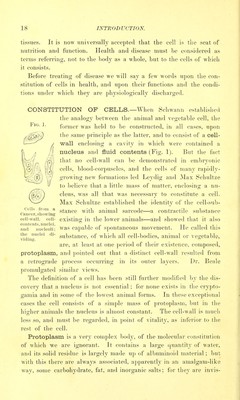
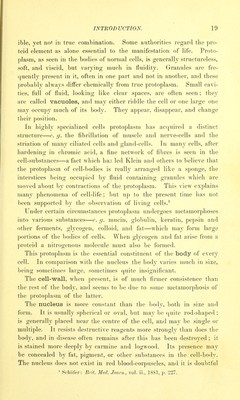
![tissues. It is now universally accepted that the cell is the seat of nutrition and function. Health and disease must be considered as terms referring, not to the body as a whole, but to the cells of which it consists. Before treating of disease w^e will say a few words upon the con- stitution of cells in health, and upon their functions and the condi- tions under which they are physiologically discharged. CONSTITUTION OF CELLS.—When Schwann established the analogy between the animal and vegetable cell, the Fig. 1. former was held to be constructed, in all cases, upon the same principle as the latter, and to consist of a cell- wall enclosing a cavity in which were contained a nucleus and fluid contents (Fig. 1). But the fact that no cell-wall can be demonstrated in embryonic cells, blood-corpuscles, and the cells of many rapidly- growing new formations led Leydig and Max Schultze to believe that a little mass of matter, enclosing a nu- cleus, Avas all that was necessary to constitute a cell. Max Schultze established the identity of the cell-sub- Ceiis from a g^g^j;^^.^ vfith animal sarcode—a contractile substance Cancer, showing cell-wall, cell- existing in the lower animals—and showed that it also contents,nuclei. i i r« , ^ TJ ii wi • and nucleoli; was Capable 01 Spontaneous movement. He called this the nuclei di- guj^gtance, of Avhich all cell-bodies, animal or veoretable, viding. ' ' o ' are, at least at one period of their existence, composed, protoplasm, and pointed out that a distinct cell-Avall resulted from a retrograde process occurring in its outer layers. Dr. Beale promulgated similar views. The definition of a cell has been still further modified by the dis- covery that a nucleus is not essential; for none exists in the crypto- gamia and in some of the lowest animal forms. In these exceptional cases the cell consists of a simple mass of protoplasm, but in the higher animals the nucleus is almost constant. The cell-Avall is much less so, and must be regarded, in point of vitality, as inferior to the rest of the cell. Protoplasm is a very complex body, of the molecular constitution of Avhich we are ignorant. It contains a large quantity of water, and its solid residue is largely made u]) of albuminoid material; but with this there are ahvays associated, apparently in an amalgam-like way, some carbohydrate, fat, and inorganic salts; for they are invis-](https://iiif.wellcomecollection.org/image/b20420304_0028.jp2/full/800%2C/0/default.jpg)
 No text description is available for this image
 No text description is available for this image
 No text description is available for this image