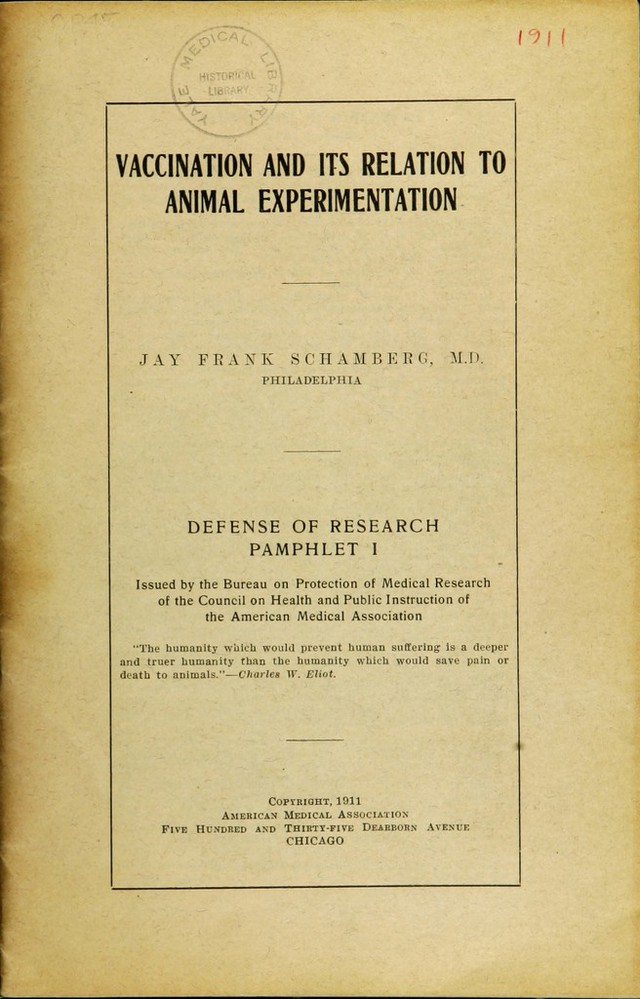
Vaccination and its relation to animal experimentation / Jay Frank Schamberg.
- Schamberg, Jay Frank, 1870-1934.
- Date:
- 1911
Licence: Public Domain Mark
Credit: Vaccination and its relation to animal experimentation / Jay Frank Schamberg. Source: Wellcome Collection.
Provider: This material has been provided by the Harvey Cushing/John Hay Whitney Medical Library at Yale University, through the Medical Heritage Library. The original may be consulted at the Harvey Cushing/John Hay Whitney Medical Library at Yale University.
6/60 page 4
![It is alleged that in Mexico smallpox has exterminated whole tribes of Indians, sparing no one to tell the story of the annihilation. Bobertson refers to smallpox among the South Ameri- can Indians as follows :5 In consequence of this [various calamities], together with the introduction of the smallpox, a malady unknown in Amer- ica, and extremely fatal to the natives, the number of the peo- ple both in New Spain and Peru was so much reduced that in a few years the accounts of their ancient population appeared almost incredible. Catlin6 states that, of 12,000,000 American Indians, 6,000,000 fell victims to smallpox. Washington Irving's Astoria makes mention of ter- rible epidemics of smallpox among the Indians in which almost entire tribes were destroyed. Lloyd, who translated Prince Maximilian's Travels in the Interior of North America, states in the preface, in reference to- a smallpox epidemic among the Indians in 1837: The Big-Bellied Indians and the Ricarees, lately amounting to 4,000 souls, were reduced to less than the half. The As- siniboins, 9,000 in number . . . are, in the literal sense of the expression, nearly exterminated.' According to records published by the government of Denmark, a devastating epidemic of smallpox appeared m Iceland in 1707 which destroyed 18,000 out of the 50,000 inhabitants; 36 per cent, of the total population perished. It is stated on good authority that in the Danish colony of Greenland, in 1734, 6',000 to 7,000 persons perished from smallpox, representing nearly two- thirds of the population. The disease was introduced by a Danish ship. The natives of New England likewise suffered great losses by smallpox. Eobertson writes : At the same time, about 1631, the smallpox, a distemper fatal to the people of the New World, swept such multitudes of the natives that some whole tribes disappeared. In 1752 Boston had a severe epidemic of this dread disease. The population of Boston at that time was 5. Robertson, William : History of the Discovery and Settlement of America. 1829. p. 348. 6. Catlin: Letters and Notes on the Manners, Customs and Conditions of the North American Indians, London, 1841. 7. Extracts from a paper prepared by Sir. John Simon in 1837, and presented bv him before the Royal Commission on Vaccination](https://iiif.wellcomecollection.org/image/b21005047_0006.jp2/full/800%2C/0/default.jpg)