Vaccination and its relation to animal experimentation / Jay Frank Schamberg.
- Schamberg, Jay Frank, 1870-1934.
- Date:
- 1911
Licence: Public Domain Mark
Credit: Vaccination and its relation to animal experimentation / Jay Frank Schamberg. Source: Wellcome Collection.
Provider: This material has been provided by the Harvey Cushing/John Hay Whitney Medical Library at Yale University, through the Medical Heritage Library. The original may be consulted at the Harvey Cushing/John Hay Whitney Medical Library at Yale University.
7/60 page 5
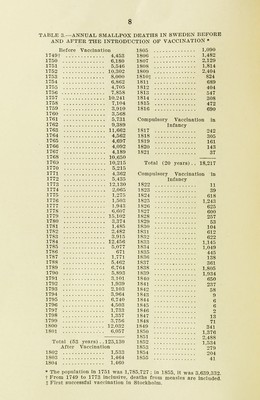
![15,684; of this number, 5,998 had previously had small- pox. During the epidemic 5,545 persons contracted the disease in the usual manner, and 2,124 took it by inocu- lation. Eighteen hundred and forty-three people es- caped from the town to avoid the danger of infection.8 There were, therefore, left in the city but 174 people who had never had smallpox. The population at the end of the epidemic practically consisted of persons who bad survived an attack of this fear-inspiring malady. CHANGE IN THE AGE INCIDENCE OF SMALLPOX Smallpox was essentially a disease of children in for- mer times; to such an extent was this true that the dis- ease was called Kindspocken (childpox, or Kindshlat- tern). Owing to the pronounced contagiousness of the disease and the almost universal susceptibility to it, smallpox was largely contracted during child life, as measles is at the present time. But comparatively few adults contract measles at the present day because they are protected by a previous attack in infancy or child- hood. The same conditions obtained with relation to smallpox in the days before vaccination. The adult population represented mostly the survivors from small- pox in childhood. It was estimated that only about 5 per cent, of persons were naturally insusceptible to the disease. Vaccination has totally changed the age period of smallpox. It is now excessively rare for a success- fully vaccinatec] child under five years of age to die of the smallpox; it is even uncommon for a successfully vaccinated child under ten years of age to die of the disease, as was adequately proved in the testimony pre- sented before the British Royal Commission on Vaccina- tion. The almost exclusive mortality of smallpox among in- fants and children in the days before vaccination is exemplified in the smallpox statistics of Kilmarnock from 1728 to 1764, a period of thirty-one years. During this time the total deaths were 3,860, and the deaths from smallpox 622. There were nine epidemics of small- pox recurring at intervals of about four years. Of the 622 smallpox deaths, 586 were in children under six years of age, 27 occurred in persons over the age of six, and the age of nine persons were not known.](https://iiif.wellcomecollection.org/image/b21005047_0007.jp2/full/800%2C/0/default.jpg)




 No text description is available for this image
 No text description is available for this image
 No text description is available for this image