Dublin's medical schools : a biographical retrospect / [William Doolin].
- William Doolin
- Date:
- 1952
Licence: Public Domain Mark
Credit: Dublin's medical schools : a biographical retrospect / [William Doolin]. Source: Wellcome Collection.
17/40 (page 11)
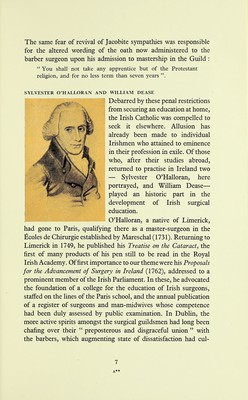
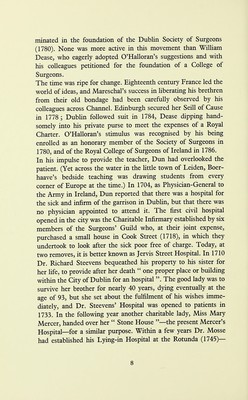
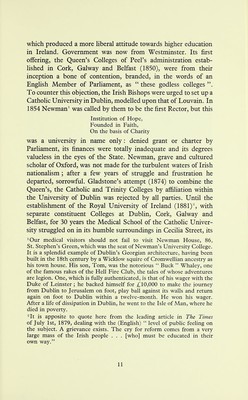
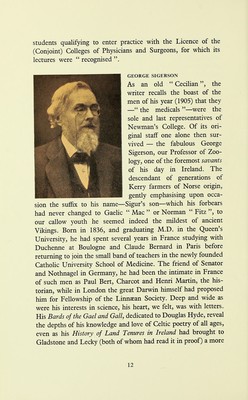
![which produced a more liberal attitude towards higher education in Ireland. Government was now from Westminster. Its first offering, the Queen's Colleges of Peel's administration estab- lished in Cork, Galway and Belfast (1850), were from their inception a bone of contention, branded, in the words of an English Member of Parliament, as these godless colleges . To counter this objection, the Irish Bishops were urged to set up a Catholic University in Dublin, modelled upon that of Louvain. In 1854 Newman1 was called by them to be the first Rector, but this Institution of Hope, Founded in Faith, On the basis of Charity was a university in name only: denied grant or charter by Parliament, its finances were totally inadequate and its degrees valueless in the eyes of the State. Newman, grave and cultured scholar of Oxford, was not made for the turbulent waters of Irish nationalism; after a few years of struggle and frustration he departed, sorrowful. Gladstone's attempt (1874) to combine the Queen's, the Catholic and Trinity Colleges by affiliation within the University of Dublin was rejected by all parties. Until the establishment of the Royal University of Ireland (1881)2, with separate constituent Colleges at Dublin, Cork, Galway and Belfast, for 30 years the Medical School of the Catholic Univer- sity struggled on in its humble surroundings in Cecilia Street, its 1Our medical visitors should not fail to visit Newman House, 86, St. Stephen's Green, which was the seat of Newman's University College. It is a splendid example of Dublin's Georgian architecture, having been built in the 18th century by a Wicklow squire of Cromwellian ancestry as his town house. His son, Tom, was the notorious Buck Whaley, one of the famous rakes of the Hell Fire Club, the tales of whose adventures are legion. One, which is fully authenticated, is that of his wager with the Duke of Leinster ; he backed himself for £10,000 to make the journey from Dublin to Jerusalem on foot, play ball against its walls and return again on foot to Dublin within a twelve-month. He won his wager. After a life of dissipation in Dublin, he went to the Isle of Man, where he died in poverty. 2 It is apposite to quote here from the leading article in The Times of July 1st, 1879, dealing with the (English) level of public feeling on the subject. A grievance exists. The cry for reform comes from a very large mass of the Irish people . . . [who] must be educated in their own way.](https://iiif.wellcomecollection.org/image/b20457741_0017.jp2/full/800%2C/0/default.jpg)