[Report of the Medical Officer of Health for Croydon].
- Croydon (London, England). County Borough.
- Date:
- [1925]
Licence: Attribution-NonCommercial 4.0 International (CC BY-NC 4.0)
Credit: [Report of the Medical Officer of Health for Croydon]. Source: Wellcome Collection.
39/190 page 37
![37 7.—OCCUPATIONAL WORK AT CHEAM SANATORIUM AND AT HOME. Early in 1925 the Council approved the scheme set out in the following report, suggesting the development of occupational work at Cheam Sanatorium. The purpose is primarily to occupy patients pleasantly and profitably while under treatment, as a direct aid to effective treatment; but it is hoped by judicious selection of occu pations to help a certain proportion of patients to contribute sub stantially towards the household income, even in advanced cases, by continuing these occupations at the homes, or if it should prove feasible and advisable in suitable workshops to be used by them in common. [COPY.] REPORT ON OCCUPATIONAL EMPLOYMENT FOR PATIENTS UNDER TREATMENT AT CHEAM SANATORIUM. A.—Existing arrangements at other sanatoria. The representatives appointed by the Sub-Committee to ascertain the occupational facilities provided elsewhere for tuberculous patients have visited the Cheshire Joint Sanatorium, Market Drayton; the Bucks and Berks Joint Sanatorium, Peppards Common ; and the King George V. Sanatorium, Godalming, all of which are known to have developed this aspect of their work, while a previous visit had been paid to Leeds to inspect the workshop scheme in force there. My report of the 3rd September last gave some particulars of the Leeds scheme. It is possible that, as the proposals set out below develop some portion of the Leeds scheme—such as the provision of a central workshop, and perhaps some of the individual trades there adopted, e.g., brush-making and window cleaning—might be incorporated in the expanding arrangements for providing suitable occupation for tuberculous patients. It is felt, how ever, that a proportion of the heavier work undertaken under the Leeds scheme is not suited to the type of tuberculous patient treated at Cheam, and that the financial basis of the Leeds scheme, which is-entirely a private venture, is not one capable of adoption by a public authority without exten sive adjustment. The occupations provided at the other sanatoria named above are to a large extent of a distinctly lighter and more sedentary type than those followed in the Leeds scheme, and include the following:—Hand-loom weaving of cotton or silk; fancy beadwork woven on small hand-looms; basketry; raffia work; dyeing of raffia; leatherwork; netting of hammocks, rabbit-netting, etc.; knitting, fancy needlework; while a further group of occupations includes poultry keeping; rearing of blue Beveren or of Angora rabbits for the sale of their fur; carpentry ; vegetable and flower gardening; bee-keeping, etc. In each sanatorium one or more paid handicraft instructors were in charge of the work, the success of which was stated depend largely on the personality of the instructor. The instructors were usually non-resident, and received wages at the inclusive rate of £2 10s. to £3 per week for a five-hour day. A standard rate of 2/- per hour was suggested at one sana torium as a suitable wage. No cash payment was made to patients in any of the sanatoria. In all, the products of work done during certain official hours were regarded as the property of the institution, while patients were allowed to work in](https://iiif.wellcomecollection.org/image/b19786827_0039.jp2/full/800%2C/0/default.jpg)
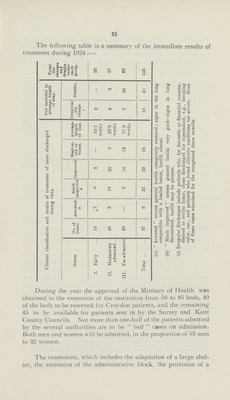
 No text description is available for this image
 No text description is available for this image
 No text description is available for this image