An account of the English colony in New South Wales from its first settlement in January 1788, to August 1801: with remarks on the dispositions, customs, manners, &c., of the native inhabitants of that country. To which are added, some particulars of New Zealand; compiled, by permission, from the MSS. of Lieutenant-Governor King: and an account of a voyage performed by Captain Flinders and Mr. Bass. By which the existence of a strait separating Van Diemen's land from the continent of New Holland was ascertained. Abstracted from the journal of Mr. Bass / By Lieutenant-Colonel Collins.
- David Collins
- Date:
- 1804
Licence: Public Domain Mark
Credit: An account of the English colony in New South Wales from its first settlement in January 1788, to August 1801: with remarks on the dispositions, customs, manners, &c., of the native inhabitants of that country. To which are added, some particulars of New Zealand; compiled, by permission, from the MSS. of Lieutenant-Governor King: and an account of a voyage performed by Captain Flinders and Mr. Bass. By which the existence of a strait separating Van Diemen's land from the continent of New Holland was ascertained. Abstracted from the journal of Mr. Bass / By Lieutenant-Colonel Collins. Source: Wellcome Collection.
42/642 page 14
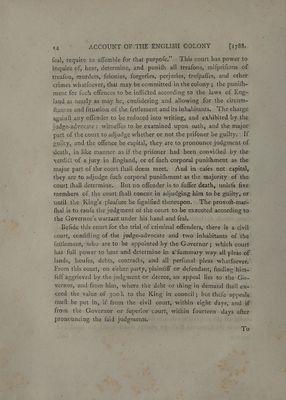
![feal, require to affemble for that purpofe.” This court has power to inquire of, hear, determine, and punifh all treafons, mifprifions of treafon, murders, felonies, forgeries, perjuries, trefpafles, and other crimes whatfoever, that may be committed in the colony; the punith- ment for fuch offences to be infli€ted according to the laws of Eng- land as nearly as may be, confidering and allowing for the circum- ftances and fituation of the fettlement and its inhabitants. The charge againft any offender to be reduced into writing, and exhibited by. the judge-advocate: witnefles to be examined upon oath, and the major part of the court to adjudge whether or not the prifoner be guilty. If guilty, and the offence be capital, they are to pronounce judgment of death, in like manner as if the prifoner had been convicted by the verdict-of a jury in England, or of fuch corporal punifhment as the major part of the court fhall deem meet. And in -cafes not. capital, they are to adjudge fuch corporal punifhment as the majority of the court fhall determine. But no offender is to fuffer death, unlefs five members of the court fhall concur in adjudging him to be guilty, or until the King’s pleafure be fignified thereupon. The provoft-mar- fhal is to caufe the judgment of the court to be executed according to the Goveraor’s warrant under his hand and feal. Befide this court for the trial of criminal offenders, there is a civil court, confifting of the judge-advocate and two inhabitants of the fettlement, who are to be appointed by the Governor ; which court has full power to hear and determine in a’f{ummary way. all pleas of — lands, houfes, debts, contra&ts, and all perfonal pleas whatfoever. From this court, on either party, plaintiff or defendant, finding him- felf aggrieved by the judgment or decree, an appeal lies to the Go- vernor, and from him, where. the debt or thing in demand {hall ex- . ceed the value of 300], to the King in council; but thefe appeals tuft be put in, if from the civil court, within eight days, and if from the Governor or fuperior court, within fourteen days after pronouncing the faid judgments. To](https://iiif.wellcomecollection.org/image/b33519675_0042.jp2/full/800%2C/0/default.jpg)