Text-book of botany, morphological and physical / by Julius Sachs ; edited, with an appendix, by Sydney H. Vines.
- Julius von Sachs
- Date:
- 1882
Licence: Public Domain Mark
Credit: Text-book of botany, morphological and physical / by Julius Sachs ; edited, with an appendix, by Sydney H. Vines. Source: Wellcome Collection.
20/1000 page 4
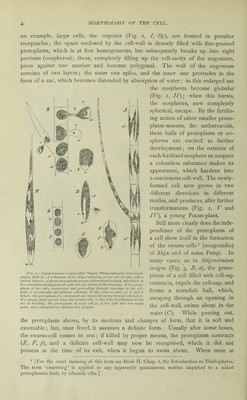
![an example, large cells, the oogonia (Fig. 2, I, Og), are formed in peculiar receptacles; the space enclosed by the cell-wall is densely filled with fine-grained protoplasm, which is at first homogeneous, but subsequently breaks up into eight portions (oospheres); these, completely filling up the cell-cavity of the oogonium, press against one another and become polygonal. The wall of the oogonium consists of two layers; the outer one splits, and the inner one protrudes in the form of a sac, which becomes distended by absorption of water; in this enlarged sac the oospheres become globular (Fig. 2, II); when this bursts, the oospheres, now completely spherical, escape. By the fertilis- ing action of other smaller proto- plasm-masses, the antherozoids, these balls of protoplasm or oo- spheres are excited to further development; on the exterior of each fertilised oosphere or oospore a colourless substance makes its appearance, which hardens into a continuous cell-wall. The newly- formed cell now grows in two different directions in different modes, and produces, after further transformations (Fig. 2, V and IV), a young Fucus-plant. Still more clearly does the inde- pendence of the protoplasm of a cell show itself in the formation of the swarm-cells* (zoogonidia) of Algae and of some Fungi. In many cases, as in SligeocIonium insigne (Fig. 3, B, a), the proto- plasm of a cell filled with cell-sap contracts, expels the cell-sap, and forms a roundish ball, which, escaping through an opening in the cell-wall, swims about in the water (C). While passing out, the protoplasm shows, by its motions and changes of form, that it is soft and extensible; but, once freed, it assumes a definite form. Usually after some hours, the swarm-cell comes to rest; if killed by proper means, the protoplasm contracts {E, F, p), and a delicate cell-wall may now be recognised, which it did not possess at the time of its exit, when it began to swim about. When once at KiG. 3.—Stigeocloniuyn (after Nageli, Pflanzenphysiol. Untersuch* ungen, Heft I); a filament of the Alga consisting of one row of cells, with a lateral branch; green protoplasm-masses (chlorophyll-bodies), imbedded in the colourless protoplasm of each cell not shown in the drawing ; B the proto- plasm of the cells contracting and protruding through openings in the cell- wall; C swarm-cells still without cell-wall; D one come to rest; at E and F killed ; the protoplasm /is contracted and shows the newly-formed cell-wall h ; H a young plant grown from the swarm-cell; O two cells of a filament in the act of dividing; the protoplasm of each cell {x, y) has split into two equal parts, and contracted by addition of a reagent. * [For the exact meaning of this term see Book II. Chap, i, the Introduction to Thallophyles. The term ‘swarming’ is applied to any apparently spontaneous motion imparted to a naked protoplasmic body by vibratile cilia.]](https://iiif.wellcomecollection.org/image/b28050976_0020.jp2/full/800%2C/0/default.jpg)



 No text description is available for this image
 No text description is available for this image
 No text description is available for this image