Text-book of botany, morphological and physical / by Julius Sachs ; edited, with an appendix, by Sydney H. Vines.
- Julius von Sachs
- Date:
- 1882
Licence: Public Domain Mark
Credit: Text-book of botany, morphological and physical / by Julius Sachs ; edited, with an appendix, by Sydney H. Vines. Source: Wellcome Collection.
29/1000 page 13
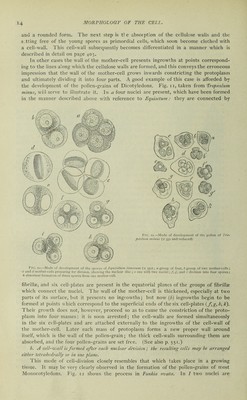
![parts, either at once or by a repeated bipartition. In the special details of cell-division, however, some deviations occur. [The first stage is, in all cases, the division of the nucleus of the mother-cell into two. This may be at once followed by the simultaneous formation of a cell-wall in the plane of the cell-plate (see infra, The Behaviour of the Nucleus during Division), as in the development of the pollen-grains of most Monocotyledons, and of the micro- spores of Isoetes; a repetition of these processes in each of the two daughter-cells leads to the formation of the four pollen-grains or spores. More commonly the cell-plate between the two nuclei undergoes absorption ; the two nuclei then divide, and the missing cell-plates are reconstituted; cellulose walls are now simultaneously formed in the cell-plates so as to divide the protoplasm into four parts, each containing a nucleus, which constitute the spores or the pollen-grains. The division of the two secondary nuclei takes place in certain cases (pollen-grains of most Monocotyledons) in one plane, and this plane is at right angles to that of the division of the nucleus of the mother-cell. As the result of this, the four spores or pollen-grains formed lie in one plane and have a rounded form; they are said to be bilateral. In other cases (pollen-grains of Dicotyledons, spores of Equisetum) the division of each secondary nucleus takes place in a plane which is at right angles to that of the other and to that of the nucleus of the mother -cell; as a consequence the four spores or pollen-grains do not lie in one plane but are arranged tetrahedrally, and have more- over a somewhat tetrahedral form; they are said to be radial. In some plants the spores or pollen-grains are formed sometimes in one way and sometimes in the other, and are therefore either bilateral or radial. This is the case, for instance, in Liverworts and Mosses: amongst Ferns, whereas in the Hymenophyllaceae and Cyatheaceae only radial spores have as yet been observed, radial spores have been found in some and bilateral spores in others of the genera of Polypodiaceae, and this is probably also the case in the Schizaeaceae and Gleicheniaceae: in the Marattiaceae and in Ophloglossum radial and bilateral spores may be produced in the same sporangium : this last condition also obtains in Psilotum and in Lycopodium Selago and inundatum: finally, these two modes of the development of the pollen-grains have been observed by Strasburger in Allium Moly among Monocotyledons. In the following paragraphs a detailed account is given of the course of development in certain cases illustrating the two modes above-mentioned. a. No cell-n.vall is produced witil after four nuclei have been formed by division; the resulting cells are arranged tetrahedrallyl\ Development of the spores of Equisetum. At first the mother-cells swim in the fluid which fills the cavity of the sporangium, in groups of two or four together (Fig. 10, a, b). Each mother-cell consists at first of a large spherical nucleus (including nu- cleoli), surrounded by fine-grained protoplasm, with a sharply-defined outline, but is without a cell-wall h [The first indication of division is the coalescence of the granules in the nucleus to form fibrillae; it becomes elongated in form, assuming a spindle-shape. An aggregation of coarse granules now makes its appearance in the equatorial plane of the spindle, constituting the nuclear disc: this splits into two discoid halves, and each half then travels to one pole of the nucleus and there forms a new nucleus. A fresh aggregation of granules now appears in the equatorial plane of the spindle, constituting the cell-plate; this extends quite across the protoplasm of the cell. The fibrillae connecting the two new nuclei with the cell-plate now disappear, and then the cell-plate also. During this time the two nuclei have begun to divide in the same way as the primary nucleus, in planes at right angles to each other and to that of the division of the primary nucleus. Six cell-plates are now formed between the four nuclei, and become connected with them by the formation of fibrillae. In the cell- ])lates cellulose walls are now formed and the division is complete. The protoplasm of each of the young spores rounds itself off, and its nucleus assumes a central position ' [According to Strasburger (loc. cit.) a delicate cell-wall is present.]](https://iiif.wellcomecollection.org/image/b28050976_0029.jp2/full/800%2C/0/default.jpg)

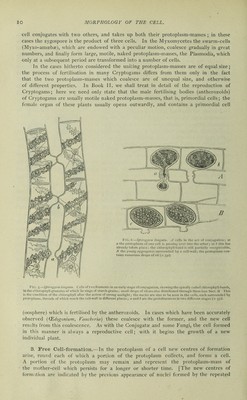
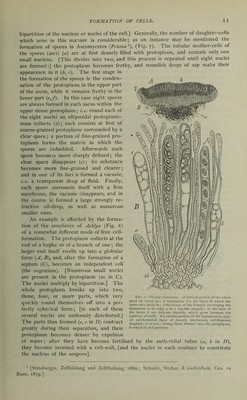
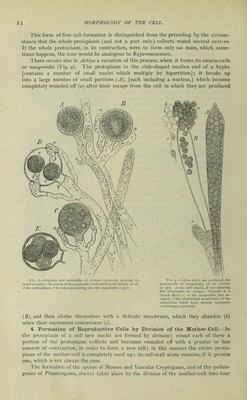
 No text description is available for this image
 No text description is available for this image
 No text description is available for this image