Lessons in elementary anatomy / by St. George Mivart.
- St. George Jackson Mivart
- Date:
- 1873
Licence: Public Domain Mark
Credit: Lessons in elementary anatomy / by St. George Mivart. Source: Wellcome Collection.
Provider: This material has been provided by The University of Glasgow Library. The original may be consulted at The University of Glasgow Library.
72/574 page 40
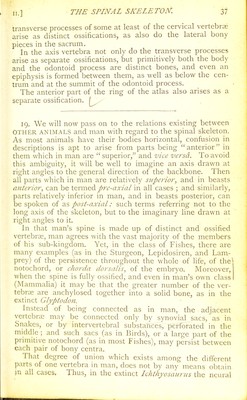
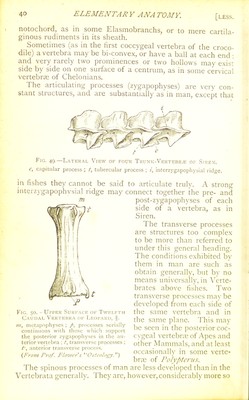
![notochord, as in some Elasmobranchs, or to mere cartila- ginous rudiments in its sheath. Sometimes (as in the first coccygeal vertebra of the croco- dile) a vertebra may be bi-convex, or have a ball at each end ; and very rarely two prominences or two hollows may exist side by side on one surface of a centrum, as in some cer\ ical vertebras of Chelonians. The articulating processes (zygapophyses) are very con- stant structures, and are substantially as in man, except that i Fig. 49—Lateral View of vow. Trunk-Vertebr.-e of .Sire.v. c, capitular process ; i, tubercular process ; /, interz)-gapopliysi3l ridge. in fishes they cannot be said to articulate truly. A strong interz)gapophvsial ridge may connect together the pre- and post-zygapophyses of each side of a vertebra, as in Siren. The transverse processes are structures too complex to be more than referred to under this general heading. The conditions exhibited by them in man are such as obtain generally, but by no means universally, in Verte- brates above fishes. Two transverse processes may be devclojjed from each side of the same vertebra and in the same plnnc. This may be seen in the posterior coc- cN gcal vertebr.'E of Apes and other Mammals, and at least occasionally in some vertc- br;i: of Poh'p/enis. The spinous processes of man are less (lc\'clopcd than in the Vcrtcbrata gencrall)-. 'fhcy arc, however, considerably more so Fig. 50. - Upi'Er Suri'Ale ok Twelfth Cauual Vertedha in' I,i-;oi>aki), 3. j/i, nicla]inphyscs ; processes serially continuous with those which support the posterior zygapophyses in the an- terior vertebra ; /, transverse processes ; anterior transverse process. {From Prof. F/owrr's Os!i-o/(\c;j.)](https://iiif.wellcomecollection.org/image/b21462641_0072.jp2/full/800%2C/0/default.jpg)




 No text description is available for this image
 No text description is available for this image
 No text description is available for this image