A practical study of malaria / by William H. Deaderick.
- Deaderick, William H. (William Heiskell), 1876-1945
- Date:
- 1909
Licence: Public Domain Mark
Credit: A practical study of malaria / by William H. Deaderick. Source: Wellcome Collection.
Provider: This material has been provided by the Augustus C. Long Health Sciences Library at Columbia University and Columbia University Libraries/Information Services, through the Medical Heritage Library. The original may be consulted at the the Augustus C. Long Health Sciences Library at Columbia University and Columbia University.
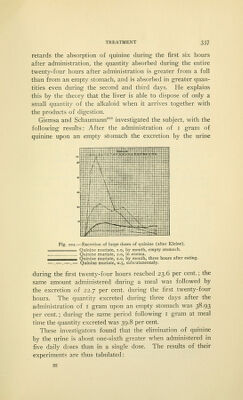
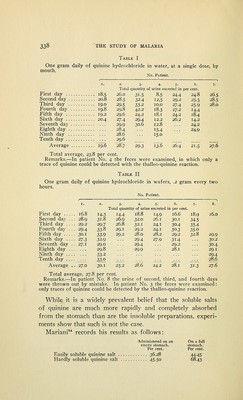
427/520 (page 333)
![of residence and I of hemoglobinuria fever for each seventy- four months, none of which were fatal. Thus, while malaria was reduced by half, the morbidity of blackwater fever was lowered to one-fourth. The lowered mortality of these cases is even still more remarkable; similar results were observed by Moffatt.263 Even Koch90 believes that through appropriate quinine prophylaxis not only malaria, but blackwater fever in an overwhelming majority of instances can be exterminated. The prophylaxis of hemoglobinuric fever consists of the prophylaxis and proper treatment of malaria. There are two chief methods in vogue for the use of quinine as a preventive of hemoglobinuric fever: Plehn's method, ^2 gram every fifth evening, and Koch's, 1 gram on two successive days. The results of A. Plehn, recorded above, were obtained with ]/2 -gram prophylaxis, but Ruge158 maintains that better consequences follow Koch's method, and gives the following figures: According to the 1903 statistics of Cameroon, there were among those who used quinine regularly 12 cases of blackwater fever, of which 8 employed the Plehn method, 3 first Plehn's, then Koch's, and only 1 Koch's method regularly. Of 35 cases among irregular users 17 employed the J^-gram method and only 3 the i-gram method. From these figures it is evident that Koch's method is preferable even when not systematically employed. It is necessary to persist in prophylaxis not only while in the blackwater fever district, but for several months there- after. As a majority of the first cases occur from the second to the fourth year of residence, it is evident that greater care should be exerted during this period.](https://iiif.wellcomecollection.org/image/b21224432_0427.jp2/full/800%2C/0/default.jpg)