The cell in development and inheritance / by Edmund B. Wilson.
- Edmund Beecher Wilson
- Date:
- 1902, ©1900
Licence: Public Domain Mark
Credit: The cell in development and inheritance / by Edmund B. Wilson. Source: Wellcome Collection.
Provider: This material has been provided by the Francis A. Countway Library of Medicine, through the Medical Heritage Library. The original may be consulted at the Francis A. Countway Library of Medicine, Harvard Medical School.
107/522 (page 79)
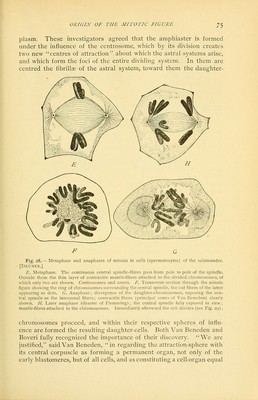
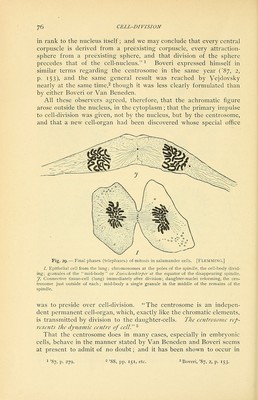
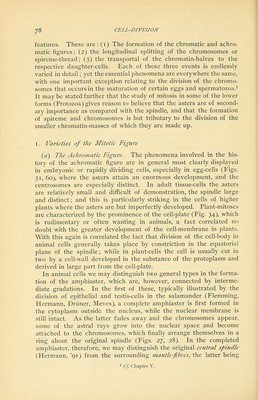
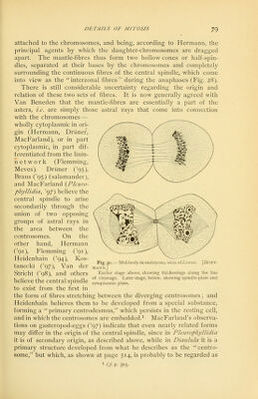
![attached to the chromosomes, and being, according to Hermann, the principal agents by which the daughter-chromosomes are dragged apart. The mantle-fibres thus form two hollow cones or half-spin- dles, separated at their bases by the chromosomes and completely surrounding the continuous fibres of the central spindle, which come into view as the interzonal fibres during the anaphases (Fig. 28). There is still considerable uncertainty regarding the origin and relation of these two sets of fibres. It is now generally agreed with Van Beneden that the mantle-fibres are essentially a part of the asters, i.e. are simply those astral rays that come into connection with the chromosomes — wholly cytoplasmic in ori- gin (Hermann, Driiner, MacFarland), or in part cytoplasmic, in part dif- ferentiated from the linin- network (Flemming, Meves). Driiner ('95), Braus ('95) (salamander), and MacFarland {Pleiiro- phyllidia, '97) believe the central spindle to arise secondarily through the union of two opposing groups of astral rays in the area between the centrosomes. On the other hand, Hermann ('91), Flemming ('91), Heidenhain ('94), Kos- tanecki ('97), Van der Stricht ('98), and others believe the central spindle to exist from the first in the form of fibres stretching between the diverging centrosomes; and Heidenhain believes them to be developed from a special substance, forming a primary centrodesmus, which persists in the resting cell, and in which the centrosomes are embedded.^ MacFarland's observa- tions on gasteropod-eggs ('97) indicate that even nearly related forms may differ in the origin of the central spindle, since in Pleiirophyllidia it is of secondary origin, as described above, while in Diaulula it is a primary structure developed from what he describes as the centro- some, but which, as shown at page 314, is probably to be regarded as ^ Cf. p. 315- Fig. 30. — Mid-bod}' in embryonic cells olLimax. [HOFF- MANN.] Earlier stage above, showing thickenings along the line of cleavage. Later stage, below, showing spindle-plate and cytoplasmic plate.](https://iiif.wellcomecollection.org/image/b21166493_0107.jp2/full/800%2C/0/default.jpg)