The cell in development and inheritance / by Edmund B. Wilson.
- Edmund Beecher Wilson
- Date:
- 1902, ©1900
Licence: Public Domain Mark
Credit: The cell in development and inheritance / by Edmund B. Wilson. Source: Wellcome Collection.
Provider: This material has been provided by the Francis A. Countway Library of Medicine, through the Medical Heritage Library. The original may be consulted at the Francis A. Countway Library of Medicine, Harvard Medical School.
108/522 (page 80)
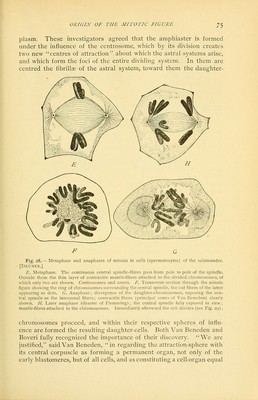
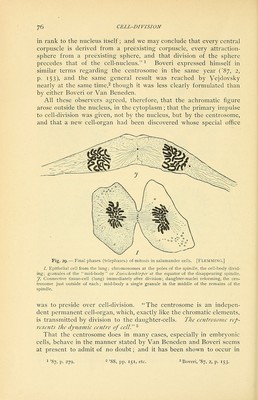
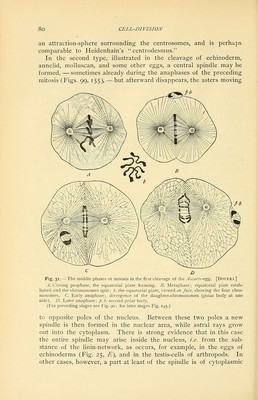
![an attraction-sphere surrounding the centrosomes, and is perhaps comparable to Heidenhain's centrodesmus. In the second type, illustrated in the cleavage of echinoderm, anneHd, molluscan, and some other eggs, a central spindle may be formed, —sometimes already during the anaphases of the preceding mitosis (Figs. 99, 155), — but afterward disappears, the asters moving Fig. 31. — The middle phases ot mitosis in the first cleavage of the Ascaris-egg. [BOVERI.] .4. Closing prophase, the equatorial plate forming. B. Metaphase; equatorial plate estab- lished and the chromosomes split; d. the equatorial plate, viewed en face, showing the four chro- mosomes. C. Early anaphase; divergence of the daughter-chromosomes (polar body at one side). D. Later anaphase; /. b. second polar body. (For preceding stages see Fig. 90; for later stages Fig. 145.) to opposite poles of the nucleus. Between these two poles a new spindle is then formed in the nuclear area, while astral rays grow out into the cytoplasm. There is strong evidence that in this case the entire spindle may arise inside the nucleus, i.e. from the sub- stance of the linin-network, as occurs, for example, in the eggs of echinoderms (Fig. 2$, E), and in the testis-cells of arthropods. In other cases, however, a part at least of the spindle is of cytoplasmic](https://iiif.wellcomecollection.org/image/b21166493_0108.jp2/full/800%2C/0/default.jpg)