The cell in development and inheritance / by Edmund B. Wilson.
- Edmund Beecher Wilson
- Date:
- 1902, ©1900
Licence: Public Domain Mark
Credit: The cell in development and inheritance / by Edmund B. Wilson. Source: Wellcome Collection.
Provider: This material has been provided by the Francis A. Countway Library of Medicine, through the Medical Heritage Library. The original may be consulted at the Francis A. Countway Library of Medicine, Harvard Medical School.
117/522 (page 89)
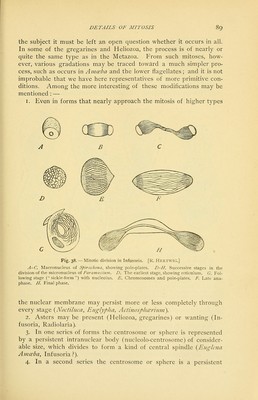
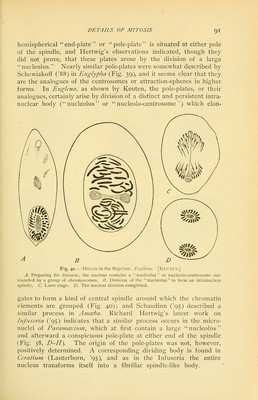
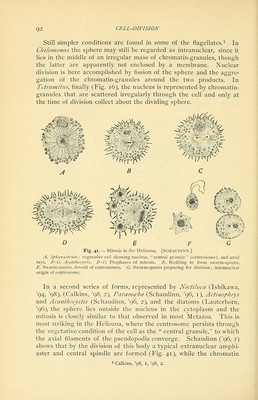
![the subject it must be left an open question whether it occurs in all. In some of the gregarines and Heliozoa, the process is of nearly or quite the same type as in the Metazoa. From such mitoses, how- ever, various gradations may be traced toward a much simpler pro- cess, such as occurs in Aniceba and the lower flagellates; and it is not improbable that we have here representatives of more primitive con- ditions. Among the more interesting of these modifications may be mentioned : — I. Even in forms that nearly approach the mitosis of higher types B D Fig. 38. — Mitotic division in Infusoria. [R. Hertwig.] A-C. Macronucleus of Spirochona, sliowing pole-plates. D-H. Successive stages in the division of the micronucleus of/ta^-flWAT/ww. D. The earliest stage, showing reticulum. G. Fol- lowing stage ( sickle-form ) with nucleolus. E. Chromosomes and pole-plates. F. Late ana- phase. H. Final phase. the nuclear membrane may persist more or less completely through every stage {Noctihica, EiiglypJia, ActinospJicEriiini). 2. Asters maybe present (Hehozoa, gregarines) or wanting (In- fusoria, Radiolaria). 3. In one series of forms the centrosome or sphere is represented by a persistent intranuclear body (nucleolo-ccntrosome) of consider- able size, which divides to form a kind of central spindle {Eiig/iua Amoeba, Infusoria.?). 4. In a second series the centrosome or sphere is a persistent](https://iiif.wellcomecollection.org/image/b21166493_0117.jp2/full/800%2C/0/default.jpg)