The cell in development and inheritance / by Edmund B. Wilson.
- Edmund Beecher Wilson
- Date:
- 1902, ©1900
Licence: Public Domain Mark
Credit: The cell in development and inheritance / by Edmund B. Wilson. Source: Wellcome Collection.
Provider: This material has been provided by the Francis A. Countway Library of Medicine, through the Medical Heritage Library. The original may be consulted at the Francis A. Countway Library of Medicine, Harvard Medical School.
120/522 (page 92)
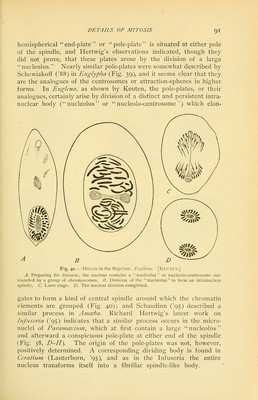
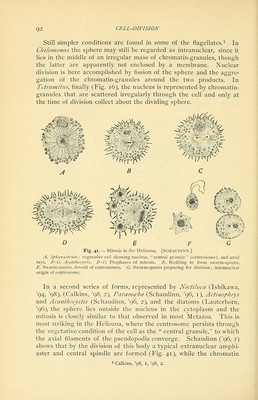
![Still simpler conditions are found in some of the flagellates.^ In Chilonwnas the sphere may still be regarded as intranuclear, since it lies in the middle of an irregular mass of chromatin-granules, though the latter are apparently not enclosed by a membrane. Nuclear division is here accomplished by fission of the sphere and the aggre- gation of the chromatin-granules around the two products. In Tetramitus, finally (Fig. i6), the nucleus is represented by chromatin- granules that are scattered irregularly through the cell and only at the time of division collect about the dividing sphere. B C ..^ O E F C Fig. 41. — Mitosis in the Heliozoa. [Schaudinn.] A. Spharastriim ; vegetative cell showing nucleus, central granule (centrosome), and axial rays. B-G. Acanthocystis. B~D. Prophases of mitosis. E. Budding to form swarm-spores. F. Swarm-spores, devoid of centrosomes. G. Swarm-spores preparing for division ; intranuclear origin of centrosome. In a second series of forms, represented by Noctiliica (Ishikawa, '94, '98), (Calkins, '98, 2), Parainoeba (Schaudinn, '96, i), Actinophrys and AcantJiocystis (Schaudinn, '96, 2), and the diatoms (Lauterborn, '96), the sphere lies outside the nucleus in the cytoplasm and the mitosis is closely similar to that observed in most Metazoa. This is most striking in the Heliozoa, where the centrosome persists through the vegetative condition of the cell as the central granule, to which the axial filaments of the pseudopodia converge. Schaudinn ('96, 2) shows that by the division of this body a typical extranuclear amphi- aster and central spindle are formed (Fig. 41), while the chromatin 1 Calkins, '98, i, '98, 2.](https://iiif.wellcomecollection.org/image/b21166493_0120.jp2/full/800%2C/0/default.jpg)