The cell in development and inheritance / by Edmund B. Wilson.
- Edmund Beecher Wilson
- Date:
- 1902, ©1900
Licence: Public Domain Mark
Credit: The cell in development and inheritance / by Edmund B. Wilson. Source: Wellcome Collection.
Provider: This material has been provided by the Francis A. Countway Library of Medicine, through the Medical Heritage Library. The original may be consulted at the Francis A. Countway Library of Medicine, Harvard Medical School.
121/522 (page 93)
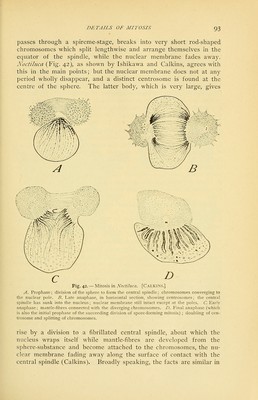
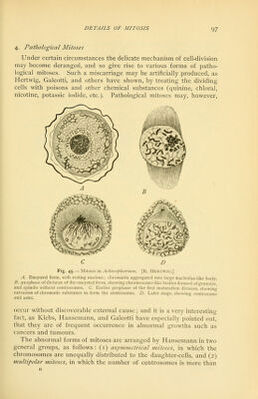
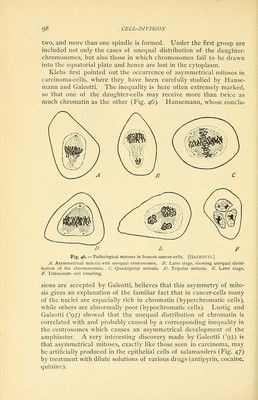
![passes through a spireme-stage, breaks into very short rod-shaped chromosomes which spht lengthwise and arrange themselves in the equator of the spindle, while the nuclear membrane fades away. Noctihica (Fig. 42), as shown by Ishikawa and Calkins, agrees with this in the main points; but the nuclear membrane does not at any period wholly disappear, and a distinct centrosome is found at the centre of the sphere. The latter body, which is very large, gives '•:: ^. D Fig. 42. — Mitosis in Noctihica. [Calkins.] A. Prophase; division of the sphere to form the central spindle; chromosomes converging to the nuclear pole. B. Late anaphase, in horizontal section, showing centrosomes; the central spindle has sunk into the nucleus; nuclear membrane still intact except at the poles. C. Early anaphase; mantle-fibres connected with the diverging chromosomes. D. Final anaphase (which is also the initial prophase of the succeeding division of spore-forming mitosis) ; doubling of cen- trosome and splitting of chromosomes. rise by a division to a fibrillated central spindle, about which the nucleus wraps itself while mantle-fibres are developed from the sphere-substance and become attached to the chromosomes, the nu- clear membrane fading away along the surface of contact with the central spindle (Calkins). Broadly speaking, the facts are similar in](https://iiif.wellcomecollection.org/image/b21166493_0121.jp2/full/800%2C/0/default.jpg)