The cell in development and inheritance / by Edmund B. Wilson.
- Edmund Beecher Wilson
- Date:
- 1902, ©1900
Licence: Public Domain Mark
Credit: The cell in development and inheritance / by Edmund B. Wilson. Source: Wellcome Collection.
Provider: This material has been provided by the Francis A. Countway Library of Medicine, through the Medical Heritage Library. The original may be consulted at the Francis A. Countway Library of Medicine, Harvard Medical School.
125/522 (page 97)
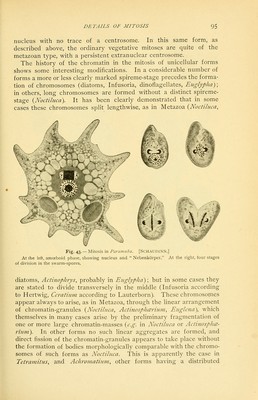
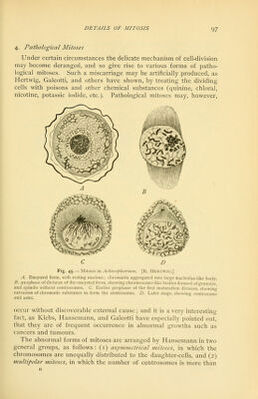
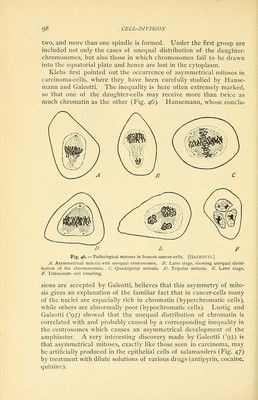
![4. Pathological Mitoses Under certain circumstances the delicate mechanism of cell-division may become deranged, and so give rise to various forms of patho- logical mitoses. Such a miscarriage may be artificially produced, as Hertwig, Galeotti, and others have shown, by treating the dividing cells with poisons and other chemical substances (quinine, chloral, nicotine, potassic iodide, etc.). Pathological mitoses may, however. Fig. 45. — MMosis in Actinosp/icerium. [R. Hertwig.] A. Encysted form, with resting nucleus; chromatin aggregated into large nucleolus-like bod}'. B. prophase of division of the encysted form, showing chromosome-Hke bodies formed of crranules, and spindle without centrosomes. C. Earlier prophase of the first maturation division, showing extrusion of chromatic substance to form the centrosome. D. Later stage, showing- centrosome and aster. occur without discoverable external cause ; and it is a very interestino- fact, as Klebs, Hansemann, and Galeotti have especially pointed out, that they are of frequent occurrence in abnormal growths such as cancers and tumours. The abnormal forms of mitoses are arranged by Hansemann in two general groups, as follows: (i) asymmetrical mitoses, in which the chromosomes are unequally distributed to the daughter-cells, and (2) multipolar mitoses, in which the number of centrosomes is more than](https://iiif.wellcomecollection.org/image/b21166493_0125.jp2/full/800%2C/0/default.jpg)