The cell in development and inheritance / by Edmund B. Wilson.
- Edmund Beecher Wilson
- Date:
- 1902, ©1900
Licence: Public Domain Mark
Credit: The cell in development and inheritance / by Edmund B. Wilson. Source: Wellcome Collection.
Provider: This material has been provided by the Francis A. Countway Library of Medicine, through the Medical Heritage Library. The original may be consulted at the Francis A. Countway Library of Medicine, Harvard Medical School.
126/522 (page 98)
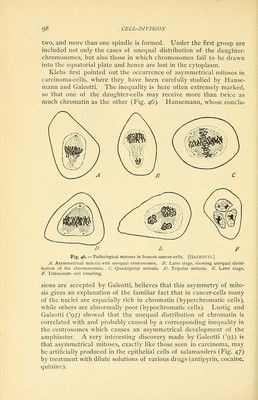
![two, and more than one spindle is formed. Under the first group are included not only the cases of unequal distribution of the daughter- chromosomes, but also those in which chromosomes fail to be drawn into the equatorial plate and hence are lost in the cytoplasm. Klebs first pointed out the occurrence of asymmetrical mitoses in carcinoma-cells, where they have been carefully studied by Hanse- mann and Galeotti. The inequality is here often extremely marked, so that one of the daughter-cells may receive more than twice as much chromatin as the other (Fig. 46). Hansemann, whose conclu- E F Fig. 46. — Pathological mitoses in human cancer-cells. [Galeotti.] A. Asymmetrical mitosis with unequal centrosomes. B. Later stage, showing unequal distri- bution of the chromosomes. C. Quadripolar mitosis. D. Tripolar mitosis. E. Later stage. F. Trinucleate cell resulting. sions are accepted by Galeotti, believes that this asymmetry of mito- sis gives an explanation of the familiar fact that in cancer-cells many of the nuclei are especially rich in chromatin (hyperchromatic cells), while others are abnormally poor (hypochromatic cells). Lustig and Galeotti ('93) showed that the unequal distribution of chromatin is correlated with and probably caused by a corresponding inequality in the centrosomes which causes an asymmetrical development of the amphiaster. A very interesting discovery made by Galeotti ('93) is that asymmetrical mitoses, exactly like those seen in carcinoma, may be artificially produced in the epithelial cells of salamanders (Fig. 47) by treatment with dilute solutions of various drugs (antipyrin, cocaine, quinine).](https://iiif.wellcomecollection.org/image/b21166493_0126.jp2/full/800%2C/0/default.jpg)