The cell in development and inheritance / by Edmund B. Wilson.
- Edmund Beecher Wilson
- Date:
- 1902, ©1900
Licence: Public Domain Mark
Credit: The cell in development and inheritance / by Edmund B. Wilson. Source: Wellcome Collection.
Provider: This material has been provided by the Francis A. Countway Library of Medicine, through the Medical Heritage Library. The original may be consulted at the Francis A. Countway Library of Medicine, Harvard Medical School.
140/522 (page 112)
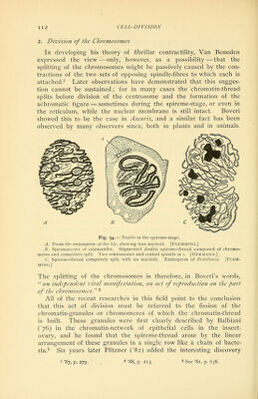
![2. Division of the Chromosomes In developing his theory of fibrillar contractility, Van Beneden expressed the view — only, however, as a possibility — that the splitting of the chromosomes might be passively caused by the con- tractions of the two sets of opposing spindle-fibres to which each is attached.^ Later observations have demonstrated that this sugges- tion cannot be sustained; for in many cases the chromatin-thread splits before division of the centrosome and the formation of the achromatic figure — sometimes during the spireme-stage, or even in the reticulum, while the nuclear membrane is still intact. Boveri showed this to be the case in Ascaris, and a similar fact has been observed by many observers since, both in plants and in animals. Fig. 54. — Nuclei in the spireme-stage. A. From the endosperm of the lily, showing true nucleoli. [Flemming.] B. Spermatocyte of salamander. Segmented double spireme-thread composed of chromo- meres and completely split. Two centrosomes and central spindle at s. [Hermann.] C. Spireme-thread completely split, with six nucleoli. Endosperm of Fritillarla. [FLEM- MING.] The splitting of the chromosomes is therefore, in Boveri's words, '■^ an independent vital manifestation, an act of 7'eprodnction on the part of the chromosomesy^ All of the recent researches in this field point to the conclusion that this act of division must be referred to the fission of the chromatin-granules or chromomeres of which the chromatin-thread is built. These granules were first clearly described by Balbiani i^'J^^ in the chromatin-network of epithelial cells in the insect- ovary, and he found that the spireme-thread arose by the linear arrangement of these granules in a single row like a chain of bacte- ria.^ Six years later Pfitzner ('82) added the interesting discovery](https://iiif.wellcomecollection.org/image/b21166493_0140.jp2/full/800%2C/0/default.jpg)