The cell in development and inheritance / by Edmund B. Wilson.
- Edmund Beecher Wilson
- Date:
- 1902, ©1900
Licence: Public Domain Mark
Credit: The cell in development and inheritance / by Edmund B. Wilson. Source: Wellcome Collection.
Provider: This material has been provided by the Francis A. Countway Library of Medicine, through the Medical Heritage Library. The original may be consulted at the Francis A. Countway Library of Medicine, Harvard Medical School.
143/522 (page 115)
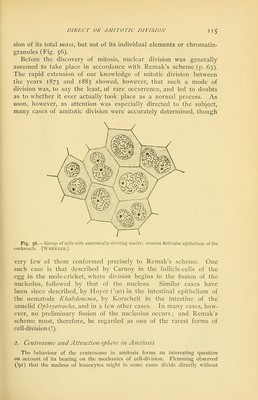
![sion of its total mass, but not of its individual elements or chromatin- granules (Fig. 56). Before the discovery of mitosis, nuclear division was generally- assumed to take place in accordance with Remak's scheme (p. 63). The rapid extension of our knowledge of mitotic division between the years 1875 and 1885 showed, however, that such a mode of division was, to say the least, of rare occurrence, and led to doubts as to whether it ever actually took place as a normal process. As soon, however, as attention was especially directed to the subject, many cases of amitotic division were accurately determined, though Fig. 56.— Group of cells with amitotically dividing nuclei; ovarian follicular epithelium of the cockroach. [Wheeler.] very few of them conformed precisely to Remak's scheme. One such case is that described by Carnoy in the follicle-cells of the Qgg in the mole-cricket, where division begins in the fission of the nucleolus, followed by that of the nucleus. Similar cases have been since described, by Hoyer('90)in the intestinal epithelium of the nematode Rhabdonema, by Korschelt in the intestine of the annelid Ophryotrocha, and in a few other cases. In many cases, how- ever, no preliminary fission of the nucleolus occurs; and Remak's scheme must, therefore, be regarded as one of the rarest forms of cell-division (!). 2. Centrosomc and Attraction-spJicrc in Auiitosis The behaviour of the centrosome in aniitosis forms an interesting question on account of its bearing on the mechanics of cell-division. Flemming obser\'ed C91) that the nucleus of leucocytes might in some cases divide directly without](https://iiif.wellcomecollection.org/image/b21166493_0143.jp2/full/800%2C/0/default.jpg)