The cell in development and inheritance / by Edmund B. Wilson.
- Edmund Beecher Wilson
- Date:
- 1902, ©1900
Licence: Public Domain Mark
Credit: The cell in development and inheritance / by Edmund B. Wilson. Source: Wellcome Collection.
Provider: This material has been provided by the Francis A. Countway Library of Medicine, through the Medical Heritage Library. The original may be consulted at the Francis A. Countway Library of Medicine, Harvard Medical School.
158/522 (page 130)
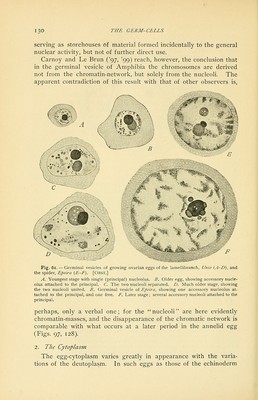
![serving as storehouses of material formed incidentally to the general nuclear activity, but not of further direct use. Carnoy and Le Brun ('97, '99) reach, however, the conclusion that in the germinal vesicle of Amphibia the chromosomes are derived not from the chromatin-network, but solely from the nucleoli. The apparent contradiction of this result with that of other observers is, Fig. 61. — Germinal vesicles of growing ovarian eggs of the lamellibranch, Uiiio (A-£>), and the spider, Epeira {E-F). [Obst.] A. Youngest stage with single (principal) nucleolus. B. Older egg, showing accessory nucle- olus attached to the principal. C. The two nucleoli separated. D. Much older stage, showing the two nucleoli united. E. Germinal vesicle of Epeira, showing one accessory nucleolus at- tached to the principal, and one free. F. Later stage; several accessory nucleoli attached to the principal. perhaps, only a verbal one; for the nucleoli are here evidently chromatin-masses, and the disappearance of the chromatic network is comparable with what occurs at a later period in the annelid egg (Figs. 97, 128). 2. The Cytoplasm The egg-cytoplasm varies greatly in appearance with the varia- tions of the deutoplasm. In such eggs as those of the echinoderm](https://iiif.wellcomecollection.org/image/b21166493_0158.jp2/full/800%2C/0/default.jpg)