The cell in development and inheritance / by Edmund B. Wilson.
- Edmund Beecher Wilson
- Date:
- 1902, ©1900
Licence: Public Domain Mark
Credit: The cell in development and inheritance / by Edmund B. Wilson. Source: Wellcome Collection.
Provider: This material has been provided by the Francis A. Countway Library of Medicine, through the Medical Heritage Library. The original may be consulted at the Francis A. Countway Library of Medicine, Harvard Medical School.
160/522 (page 132)
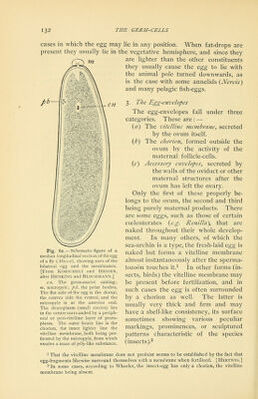
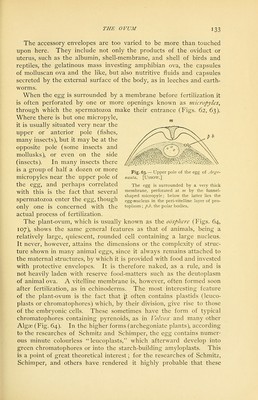
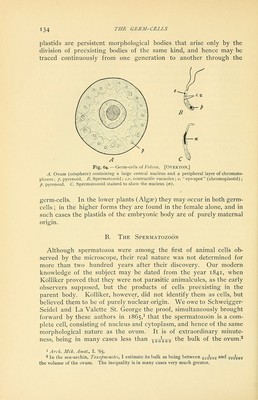
![cases in which the Q,gg may lie in any position. When fat-drops are present they usually lie in the vegetative hemisphere, and since they ^^ are hghter than the other constituents they usually cause the Q,^g to lie with the animal pole turned downwards, as is the case with some annelids (^Nereis) and many pelagic fish-eggs. pb — \ en Fig. 62.— Schematic figure of a median longitudinal section of the egg of a fly {Musca), showing axes of the bilateral egg and the membranes. [From KORSCHELT and Heider, after Henking and Blochmann.] e.n. The germ-nuclei uniting; m. micropyle; p.b. the polar bodies. The flat side of the egg is the dorsal, the convex side the ventral, and the micropyle is at the anterior end. The deutoplasm (small circles) lies in the centre surrounded by a periph- eral or peri-vitelline layer of proto- plasm. The outer heavy line is the chorion, the inner lighter line the vitelline membrane, both being per- forated by the micropyle, from which exudes a mass of jelly-like substance. 3. T/ie Egg-envelopes The egg-envelopes fall under three categories. These are : —■ {a) The vitelline membrane, secreted by the ovum itself. i^b) The choi'ion, formed outside the ovum by the activity of the maternal follicle-cells. (c) Accessory envelopes, secreted by the walls of the oviduct or other maternal structures after the ovum has left the ovary. Only the first of these properly be- longs to the ovum, the second and third being purely maternal products. There are some eggs, such as those of certain coelenterates {j^-g- Renilla), that are naked throughout their whole develop- ment. In many others, of which the sea-urchin is a type, the fresh-laid Q.g^ is naked but forms a vitelline membrane almost instantaneously after the sperma- tozoon touches it.^ In other forms (in- sects, birds) the vitelline membrane may be present before fertilization, and in such cases the Q,gg is often surrounded by a chorion as well. The latter is usually very thick and firm and may have a shell-like consistency, its surface sometimes showing various peculiar markings, prominences, or sculptured patterns characteristic of the species (insects).^ 1 That the vitelline membrane does not preexist seems to be established by the fact that egg-fragments likewise surround themselves v/ith a membrane when fertilized. [Hertwig.] 2 In some cases, according to Wheeler, the insect-egg has only a chorion, the vitelline membrane being absent.](https://iiif.wellcomecollection.org/image/b21166493_0160.jp2/full/800%2C/0/default.jpg)