The cell in development and inheritance / by Edmund B. Wilson.
- Edmund Beecher Wilson
- Date:
- 1902, ©1900
Licence: Public Domain Mark
Credit: The cell in development and inheritance / by Edmund B. Wilson. Source: Wellcome Collection.
Provider: This material has been provided by the Francis A. Countway Library of Medicine, through the Medical Heritage Library. The original may be consulted at the Francis A. Countway Library of Medicine, Harvard Medical School.
168/522 (page 140)
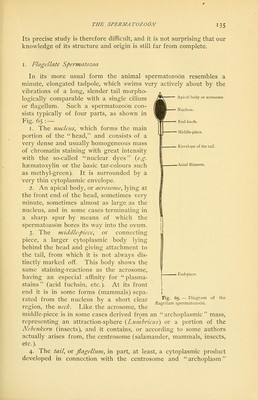
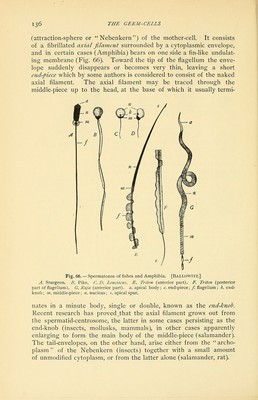
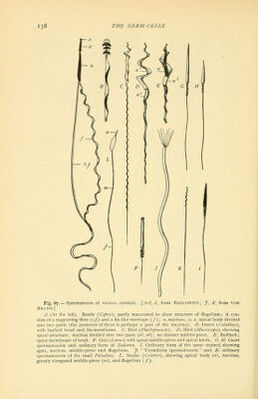
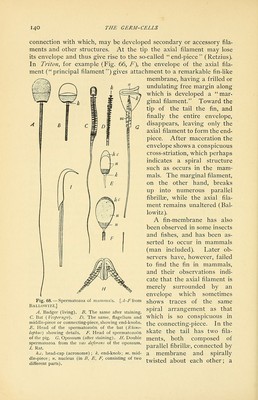
![connection with which, may be developed secondary or accessory fila- ments and other structures. At the tip the axial filament may lose its envelope and thus give rise to the so-called end-piece (Retzius). In Triton, for example (Fig. 66, F), the envelope of the axial fila- ment ( principal filament ) gives attachment to a remarkable fin-like membrane, having a frilled or - undulating free margin along which is developed a mar- ginal filament. Toward the tip of the tail the fin, and finally the entire envelope, disappears, leaving only the axial filament to form the end- piece. After maceration the envelope shows a conspicuous cross-striation, which perhaps indicates a spiral structure such as occurs in the mam- mals. The marginal filament, on the other hand, breaks up into numerous parallel fibrillae, while the axial fila- ment remains unaltered (Bal- lowitz). A fin-membrane has also been observed in some insects and fishes, and has been as- serted to occur in mammals (man included). Later ob- servers have, however, failed to find the fin in mammals, and their observations indi- cate that the axial filament is merely surrounded by an envelope which sometimes shows traces of the same spiral arrangement as that which is so conspicuous in the connecting-piece. In the skate the tail has two fila- ments, both composed of parallel fibrillae, connected by a membrane and spirally twisted about each other; a Fig. 68. — Spermatozoa of mammals. [A-I^from Ballowitz.] j4. Badger (living). B. The same after staining. C. Bat {Vesperugo). D. The same, flagellum and middle-piece or connecting-piece, showing end-knobs. E. Head of the spermatozoon of the bat {Rkino- lophus) showing details. F. Head of spermatozoon of the pig. G. Opossum (after staining). H. Double spermatozoa from the vas deferens of the opossum. /. Rat. h.c. head-cap (acrosome) ; k. end-knob; m. mid- dle-piece ; n. nucleus (in B, E, F, consisting of two different parts).](https://iiif.wellcomecollection.org/image/b21166493_0168.jp2/full/800%2C/0/default.jpg)