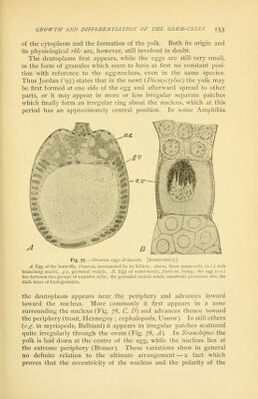
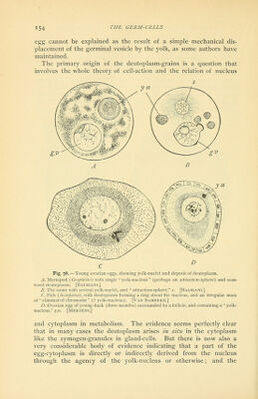
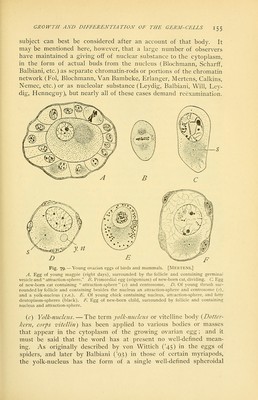
The cell in development and inheritance / by Edmund B. Wilson.
- Edmund Beecher Wilson
- Date:
- 1902, ©1900
Licence: Public Domain Mark
Credit: The cell in development and inheritance / by Edmund B. Wilson. Source: Wellcome Collection.
Provider: This material has been provided by the Francis A. Countway Library of Medicine, through the Medical Heritage Library. The original may be consulted at the Francis A. Countway Library of Medicine, Harvard Medical School.
185/522 (page 157)
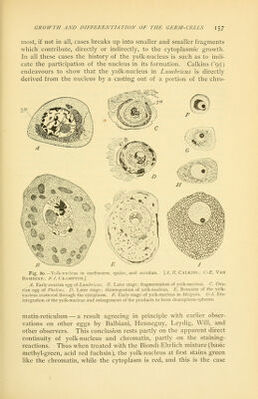
![most, if not in all, cases breaks up into smaller and smaller fragments which contribute, directly or indirectly, to the cytoplasmic growth. In all these cases the history of the yolk-nucleus is such as to indi- cate the participation of the nucleus in its formation. Calkins ('95) endeavours to show that the yolk-nucleus in Lumbriais is directly derived from the nucleus by a casting out of a portion of the chro- Fig. 80.—Yolk-nucleus in earthworm, spider, and ascidian. [.-/, B, CALKINS; C-E, VAN Bambeke; Z'-/, CRAMPTON.] A. Early ovarian <t.gg of Lumbriciis. B. Later stage; fragmentation of yolk-nucleus. C. Ova- rian egg of Pholcus. D. Later stage; disintegration of yolk-nucleus. E. Remains of the yolk- nucleus scattered through the cytoplasm. F. Early stage of yolk-nucleus in Molgula. G-I. Dis- integration of the yolk-nucleus and enlargement of the products to form deutoplasm-spheres. matin-reticulum — a result agreeing in principle with earlier obser- vations on other eggs by Balbiani, Henneguy, Ley dig, Will, and other observers. This conclusion rests partly on the apparent direct continuity of yolk-nucleus and chromatin, partly on the staining- reactions. Thus when treated with the Biondi-Ehrlich mixture (basic methyl-green, acid red fuchsin), the yolk-nucleus at first stains green like the chromatin, while the cytoplasm is red, and this is the case](https://iiif.wellcomecollection.org/image/b21166493_0185.jp2/full/800%2C/0/default.jpg)