The cell in development and inheritance / by Edmund B. Wilson.
- Edmund Beecher Wilson
- Date:
- 1902, ©1900
Licence: Public Domain Mark
Credit: The cell in development and inheritance / by Edmund B. Wilson. Source: Wellcome Collection.
Provider: This material has been provided by the Francis A. Countway Library of Medicine, through the Medical Heritage Library. The original may be consulted at the Francis A. Countway Library of Medicine, Harvard Medical School.
187/522 (page 159)
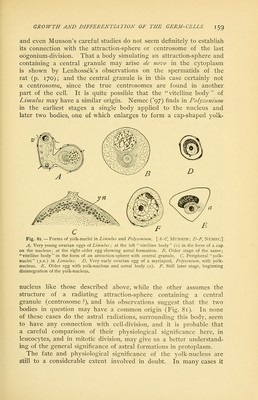
![and even Munson's careful studies do not seem definitely to establish its connection with the attraction-sphere or centrosome of the last oogonium-division. That a body simulating an attraction-sphere and containing a central granule may arise de novo in the cytoplasm is shown by Lenhossek's observations on the spermatids of the rat (p. 170); and the central granule is in this case certainly not a centrosom.e, since the true centrosomes are found in another part of the cell. It is quite possible that the vitelHne body of Liniiilus may have a similar origin. Nemec ('97) finds in Polyzoniictn in the earliest stages a single body applied to the nucleus and later two bodies, one of which enlarges to form a cap-shaped yolk- t„- o^^ ■So « 'i* o * <9- ^ 90 c Fig. 81. — Forms of yolk-nuclei in Limulus and Polyzonium. [,^-C, MUNSON; D-F, Nemec] A. Very young ovarian eggs oiLimulus; at the left vitelline body {v) in the form of a cap on the nucleus; at the right older egg showing astral formation. B. Older stage of the same; vitelline body in the form of an attraction-sphere with central granule. C. Peripheral yolk- nuclei (^.w.) in Limulus. D. Very early ovarian egg of a myriapod, Polyzonium, with yolk- nucleus. E. Older egg with yolk-nucleus and astral body \a). F. Still later stage, beginning disintegration of the yolk-nucleus. nucleus hke those described above, while the other assumes the structure of a radiating attraction-sphere containing a central granule (centrosome .?), and his observations suggest that the two bodies in question may have a common origin (Fig. 81). In none of these cases do the astral radiations, surrounding this body, seem to have any connection with cell-division, and it is probable that a careful comparison of their physiological significance here, in leucocytes, and in mitotic division, may give us a better understand- ing of the general significance of astral formations in protoplasm. The fate and physiological significance of the yolk-nucleus are still to a considerable extent involved in doubt. In many cases it](https://iiif.wellcomecollection.org/image/b21166493_0187.jp2/full/800%2C/0/default.jpg)